




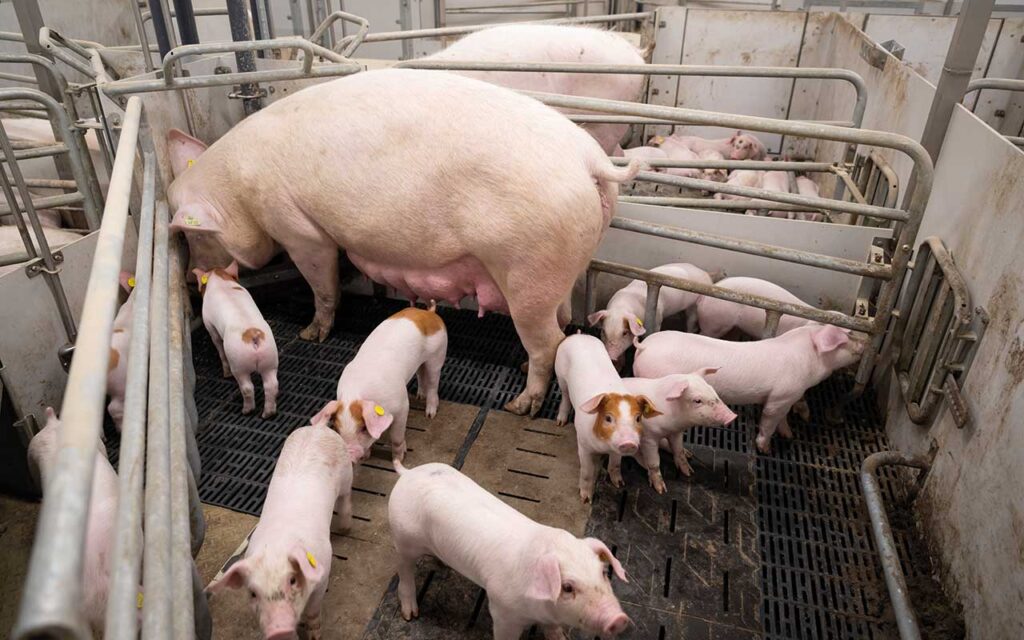
Detailed research carried out at the National Pig Centre (NPC), in Leeds, has shown that temporary crating of sows can improve piglet survival to weaning, in comparison to loose housing.
The research also found there was no discernible difference in sow welfare between loose-housed systems and various forms of temporary crating.
The findings, published in January in Science Direct, shed new light on managing the transition to flexible farrowing systems, where sows are only confined for a few days, concluding that temporary crating provides a viable alternative to the farrowing crate.
The NPC, with indoor and outdoor herds operating on a commercial scale at the University of Leeds, is the UK’s ‘largest and most advanced facility’ for pig research, Katie McDermott, its deputy director, told a Farrowing Futures workshop in February.
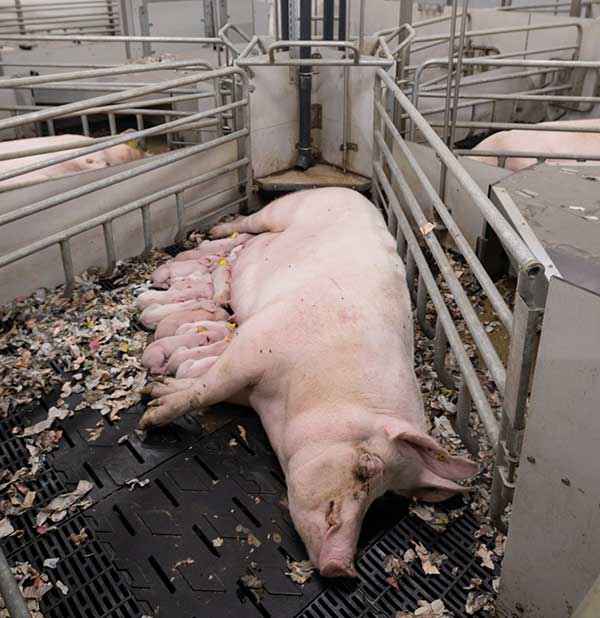
Temporary crates have been installed with a footprint of 5.76sq m (2.4×2.4m), with a closed crate size, including a trough, of 1.49sq m (2.4×0.62m) and a creep area of 0.9sq m. In the open position, the available space for the sow is about 3.52sq m.
Dr McDermott explained that the NPC decided to carry out the research because, while there is anecdotal evidence from units that have installed flexible farrowing systems, there was no scientific data on the most effective ways to use them.
The trial
The trial involved 666 sows, averaging 37.6 sows and 10 gilts per batch. The sows were split into four treatments:
- Loose housed, with no restraint (L)
- Crated for 24 hours before farrowing plus two days into lactation (C+2)
- Crated for 24 hours before farrowing plus four days into lactation (C+4)
- Loose lactation plus crated for four days into lactation (L+4).
Piglets were ear-tagged within 24 hours of birth, and all piglets were weighed at tagging, around day seven, and at weaning.
All pre-weaning mortality, including stillbirths and piglets laid on pre-tagging, were recorded, with cause of death where possible.
Sows were scored for body condition, lameness, shoulder sores and manure on body when entering and leaving the farrowing house.
To further support the research, CCTV footage was collected from one batch of farrowing sows to assess their behaviour and body position for eight days after farrowing.
Key findings
The C+4 group, confined for four days after farrowing, recorded the lowest piglet mortality at 11.8%.
This compared with 13.5% for the L+4 group that was not confined until four days into lactation, and 14.9% for the C+2 group, confined for just two days after farrowing. The completely loose-house sows recorded a pre-weaning mortality of 16.4%.
The majority of the additional mortality came in days two and three of lactation, suggesting that the timing of when crates are opened is key. Piglets from the L and C+2 groups were younger and lighter at time of death.
Loose sows had far higher laid-on mortality 24 hours after birth, at 0.65 piglets per litter versus 0.35 piglets per litter for the crated sows, again highlighting the benefits of confinement at that crucial time.
The C+4 group reared 13.7 piglets/litter, an extra 0.6 piglets compared with the 13.1 piglets/litter for the loose-housed sows. The L+4 group also weaned 13.7 piglets/litter, while the C+2 group weaned 13.4 piglets/litter.
However, another interesting finding was that litters from the C+4 group had the lowest average litter weights at 113.5kg. This compared with 117.6kg for the loose-housed sows and 116kg for the C+2 group.
The L+4 group had a weaning weight of 113.8kg. This translated into an average weaned weight per piglet of 8.78kg for the loose-housed sows, compared with 8.44kg for the C+4 group.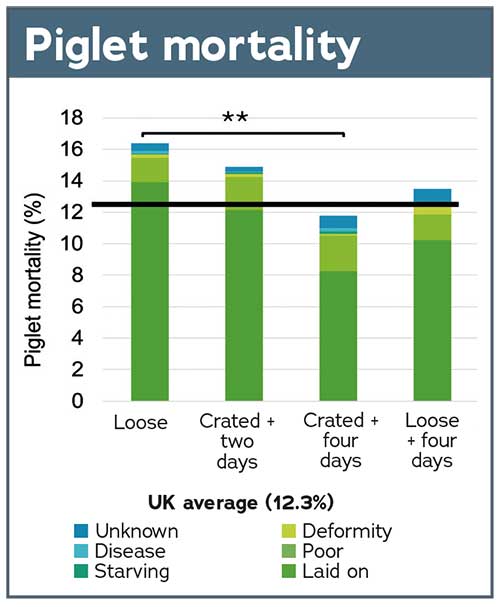
Sow behaviour and welfare
The observations also showed that temporary crating had no lasting effect on stress levels of sows across lactation. In fact, no overall difference in stress or in welfare indicators or behaviour were observed among the sows over lactation between the groups.
The sows spent more time standing, interacting with piglets and the environment when released from the crate and were more active in the morning, suggesting that it might be preferable to release sows from the crates in the afternoon, Dr McDermott said.
It was also observed that providing manipulative enrichment – for example, shredded paper – may help satisfy sow behaviour requirements when released from the crate.
Other notable observations included the extra difficulty for stockpeople of crating sows after farrowing was complete (L+4), while the research also highlighted the need to show care and attention when opening crates.
As a result of the research, sows and gilts at the NPC are now confined approximately 24 hours before farrowing and are released after four days of lactation.
“The system is working very well for us. Crating for four days is a viable alternative to current crating practices, but flexibility in the system is recommended – for example, up to seven days – due to sow and temperature variation,” Dr McDermott said.
She is hoping to carry out research in future into the management of sows at point of release and would also like to repeat the experiment across multiple commercial sites.