




Vaccination programmes represent a significant investment on pig farms – not only financially, but also in terms of the time and effort required to deliver them consistently and correctly.
Recently, my colleagues and I have been looking at whether we are getting the best possible return from that investment.
We all know that colostrum is critical to piglet survival, health and early performance. But how often do we measure what is happening on farm?
Are our vaccination programmes and management practices influencing the quality of colostrum produced by our gilts and sows? And, just as importantly, is that liquid gold actually making its way into the piglets – and consistently across the whole litter?
In my experience, when we start to measure these things on farm, the answers are often more surprising than you might expect.
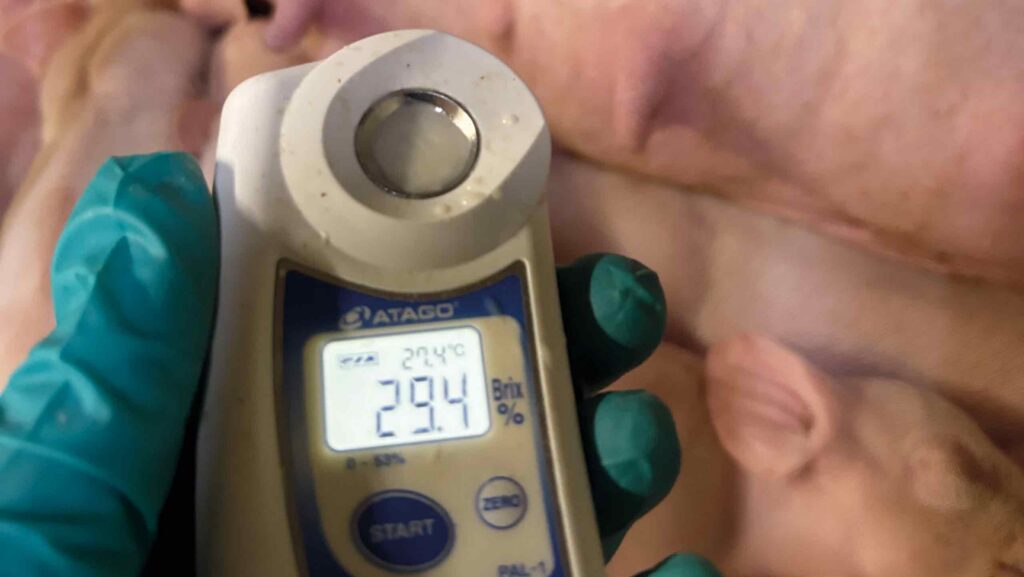
Refractometer
A Brix refractometer gives us a quick and simple way of putting a number against that quality rather than relying on appearance or assumptions.
Only a few drops of colostrum are placed on the refractometer, and within seconds we have a Brix percentage that can be recorded and compared between animals, across parities, between batches and over time.
This will create an overall picture of the herd. Are the gilts differing from older sows? Does colostrum quality change with alterations to vaccination schedules, nutrition changes or controlled-exposure programmes?
Over time, some valuable trends will undoubtedly emerge. A Brix reading of more than 20% is considered to be good colostrum quality, while 22% is considered excellent.
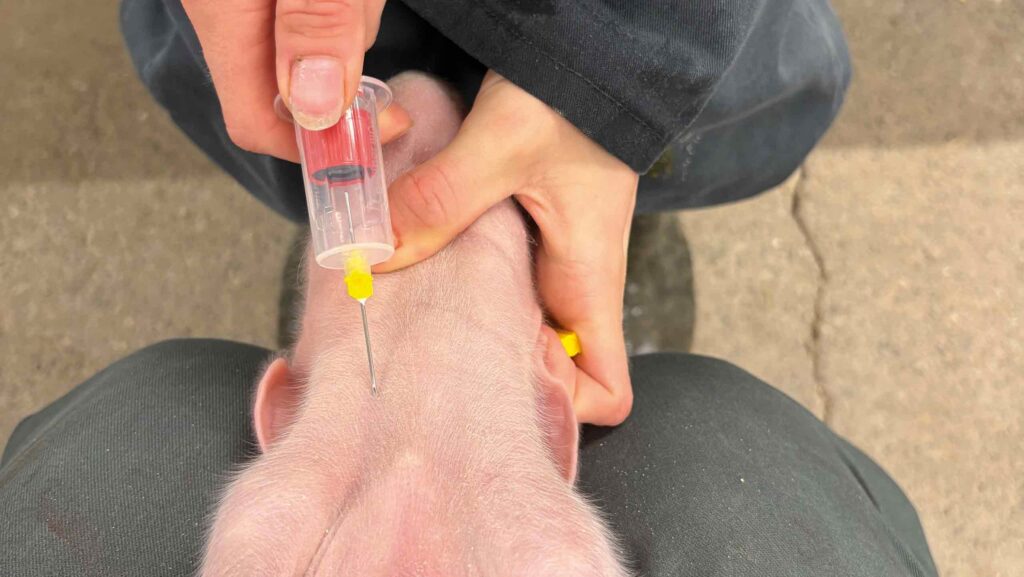
Good-quality colostrum is only the first piece of the puzzle. A sow can produce excellent colostrum and still have piglets that receive insufficient amounts. Measuring colostrum intake via piglet blood sampling can guide us on whether each piglet is getting a sufficient amount.
Piglets should ideally consume 250g of colostrum, with approximately 200g regarded as an important minimum threshold. Increasingly large litters certainly make this more challenging, as the colostrum quantity produced by each sow is a finite resource.
Piglets compete for access to the udder and it is often the smaller piglets or those born later in the birth order that miss out.
Colostral immunoglobulin concentrations are highest soon after farrowing and decline rapidly, while the piglet’s ability to absorb those antibodies from the intestine is also time limited. So those first few hours really do count.
Cross-fostering, split-suckling and the timing of farrowing house routines can all influence the opportunity individual piglets have to suckle during those crucial first hours.
Supplements
Commercial colostrum supplements certainly have a place, particularly for small, chilled or slow piglets, providing the energy boost needed to compete at the teat. But they should be viewed as a helping hand, rather than a replacement for the real thing.
Measuring both colostrum quality and colostrum intake is a powerful combination that allows us to identify any weak points and implement changes to the necessary areas. For example, if colostrum quality is under target, the focus can be placed on pre-farrowing management, vaccination timing, nutrition and the farrowing process itself.
If the transfer to the piglets is poor or variable, the focus shifts to piglet management and early litter routines. The solution will not be the same for every farm.
Colostrum really is liquid gold. It is the first investment we make in every piglet – measure it, manage it, maximise it, and make it count.