




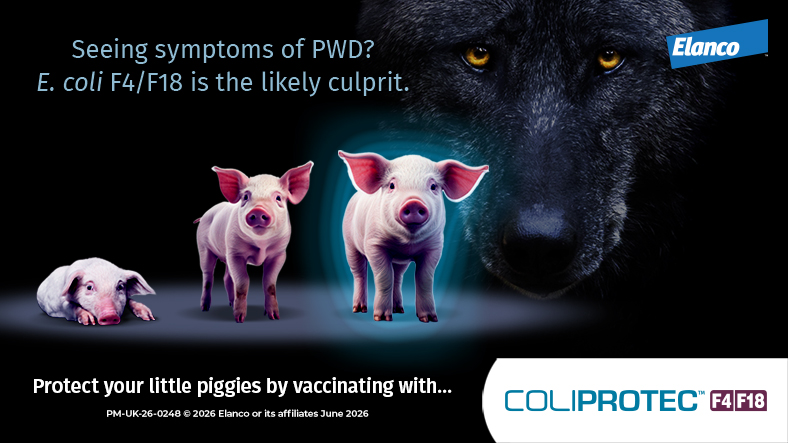
Request your free diagnostic test now.
Post-weaning diarrhoea (PWD) remains one of the most persistent gut health challenges in pig production globally, with E. coli F4/F18 causing almost 60% of cases in Europe 2.
In the UK and Europe, the removal of zinc oxide – previously used at medicinal levels in piglet feed to reduce PWD – has increased pressure on producers with fewer control options available.
At the same time, ongoing concern around antimicrobial resistance (AMR) means producers are looking for prevention-led strategies that support piglet health, performance and reduced reliance on antibiotics.
According to Pedro Sanchez, international swine business leader at Elanco, PWD should not be viewed as a challenge that begins at weaning.
“Post-weaning diarrhoea is seen after weaning, but effective control starts much earlier,” he explains.
“As a lot of herds are now producing above 30 piglets per sow per year, weight at birth and colostrum intake for example, are becoming critical for the success of the post-weaning phase.”
Building gut stability before weaning
Mr Sanchez believes effective PWD control starts with understanding the piglet’s journey from birth through to the nursery, with birth weight, colostrum intake, intestinal maturity, feed digestibility, hygiene and weaning age all influencing how well piglets cope with the post-weaning transition.
“Even with good management in place, a proportion of piglets will be underweight and may need additional support,” says Mr Sanchez.
“These piglets will have different requirements in terms of housing conditions, nutrition, vaccination, and other management practices, which should be addressed to improve their survivability in the post-weaning period.”
This means PWD control should be built around a holistic prevention strategy combining:
- Nutrition that supports feed intake and gut stability
- Good hygiene and biosecurity
- Diagnostics to identify whether F4/F18 enterotoxigenic Escherichia coli (ETEC) strains are present
- Vaccination to support intestinal immunity ahead of the main risk period
- Performance monitoring to assess the impact of control measures.
The post-weaning impact
PWD typically occurs in the first three weeks after weaning and is commonly associated with F4/F18 ETEC. 3,4
The impact of ETEC infection can include:
-
- Increased post-weaning mortality5,6,7
- Reduced weight gain8
- Greater variation within batches
However, Mr Sanchez says the impact is not limited to visible scouring or mortality.
“Two important factors are reduced growth rate and herd homogeneity,” he says.
“Producers work in batches, so reducing variation within that batch is very important for cleaning and disinfection, as well as animal movements.”
E. coli testing helps inform the plan
Elanco funds Rainbow diagnostic testing for pig producers across the UK to help identify whether F4/F18 ETEC strains are present on farm.
These tests are provided through veterinary practices and should be used at the first signs of disease to help inform the most appropriate control plan.
Where F4/F18 ETEC is identified as part of the challenge, vaccination can form part of a vet-led prevention strategy.
The role of Coliprotec
Oral vaccine, Coliprotec™ F4/F18, offers a sustainable long-term control method where F4/F18 ETEC are present.
It helps lower the incidence of PWD and reduces faecal shedding of enterotoxigenic F4/F18 E. coli from infected pigs9.
As part of a vet-led PWD control plan, Coliprotec F4/F18 can be administered orally through drinking water to pigs from 18 days of age, offering a practical route to support gut integrity ahead of the main post-weaning risk period.
“Vaccination has a key role to play in the PWD prevention toolkit,” says Mr Sanchez.
“Because the disease is multifactorial, vaccination can support broader health and performance outcomes beyond disease control alone.”
As part of a prevention-led approach, Coliprotec F4/F18 can help deliver:
- Reduced herd mortality10
- Improved growth performance11,12
- Faster time to market13
- Reduced antibiotic use14
- Protection from avoidable economic losses linked to PWD14
“Post-weaning diarrhoea is here to stay, so we have to tackle it as effectively as we can,” he says.
“By improving pre-weaning management, including vaccine administration where appropriate, producers can better support intestinal immunity and improve the chances of a smoother transition after weaning,” concludes Mr Sanchez.
1 Vangroenweghe, F. et al., 2018. Proceedings of the 10th ESPHM: 252
2 Luppi, A. et al. 2016. Porcine Health Management, 2:20. DOI: 10.1186/s40813-016-0039-9.
3 Fairbrother JM and Gyles LG, 2012. Colibacillosis. In: Diseases of Swine. Zimmerman JJ, Karriker LA, Ramirez A, Schwartz KJ and Stevenson GW. Editors. 10th Edition. John Wiley and Sons, Inc. Chapter 53, p 723-749.
4 Luppi, A. et al. 2016. Porcine Health Management, 2:20. DOI: 10.1186/s40813-016-0039-9.
5 Amezcua R et al. 2002. Can J Vet Res. 66:73-78
6 Hampson DJ. Postweaning E.coli diarrhoea in pigs. 1994. In: Escherichia coli in domestic animals and humans. Gyles CL Editor. CAB international; Chapter 8: 171-191.
7 Zhang W et al. 2007. Vet Microbiol. 123:145-152.
8 Fairbrother JM et al. 2005. Anim Health Res Rev. 6:17-39.
9 Coliprotec F4/F18 lyophilisate for oral suspension for pigs summary of product characteristics (SPC)
10 Vangroenweghe F, Van Poucke A, Defoort P. 2019. Performance and antibiotic use of piglets vaccinated with an Escherichia coli F4/F18 vaccination for the prevention of F18-ETEC postweaning diarrhea. 2019. Annual Meeting of the Belgian Society for Veterinary Epidemiology and Economics. Ghent, Belgium. DONNEES GLOBALE GAODEC complet. (2019). Data on file.
11 Elanco. Data on file. Elanco study ELA 1700757 report 2018
12 WHO 2017 – Guidelines on use of medically important antimicrobials in food-producing animals – https://apps.who.int/iris/bitstream/handle/10665/258970/978924155013-eng pdf%3bjsessionid=B982A811C8A4F2F79F5C306E2B647D62?sequence=1
13 Vangroenweghe, F. et al., 2018. Proceedings of the 10th ESPHM: 252
14 Tokach, L.M. et al. 2000. Swine Health & Production; 8: 229-233