

The words ‘EU reset and ‘SPS agreement’ are never far from our lips at the moment. For the uninitiated, this is part of the UK government’s ongoing attempts to rebuild relations with the EU, a project that will span several areas, including removing sanitary and phytosanitary (SPS) barriers to trade.
In short, the plan is to make importing and exporting easier and cheaper by aligning the UK with EU regulations. Whatever your thoughts on this, the negotiations are ongoing and it is a key priority of the government.
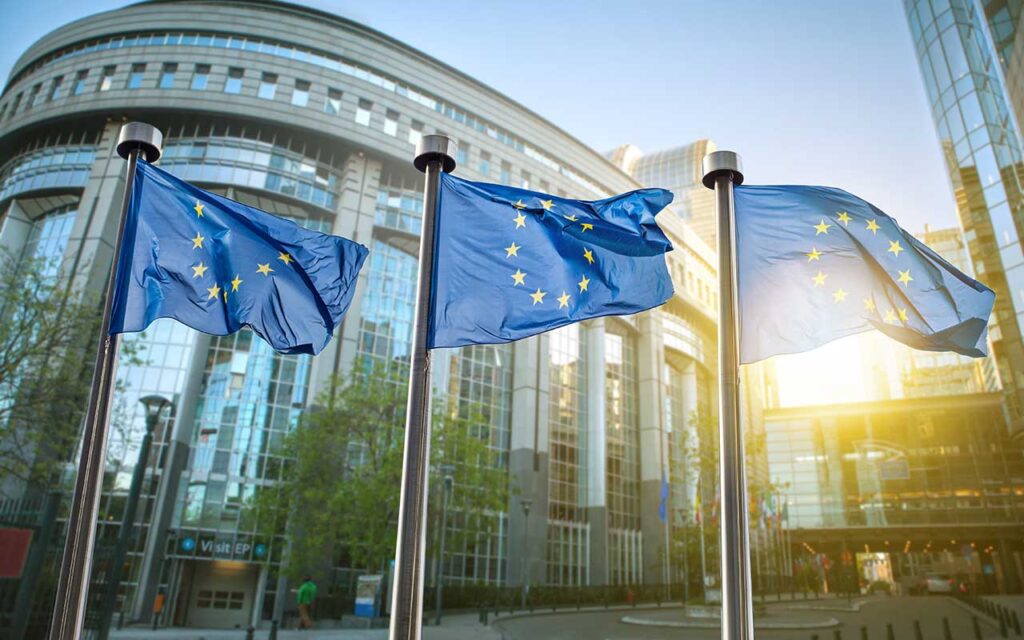
With that in mind, in mid-February, Tom Haynes, our public affairs manager, and I set off for Brussels. The aim was to meet with various stakeholders and institutions to understand how this could affect the pig industry.
We were kindly hosted by the British Agriculture Bureau (BAB), which represents the UK farming unions in Brussels. It organised a series of meetings across two days and we had many conversations, all of which were illuminating and marked the start of rebuilding relationships in Brussels.
UK influence
A question you may have, and which we certainly did, is how much influence we can expect once the agreement is in place.
Meeting with the UK Mission to the EU (UKMis) – staffed by civil servants from across the Westminster government departments – we learned the UK would have a place on the various technical committees and groups in the institutions – we just won’t have a vote.
This means the relationships between the UK and individual member states is paramount. Fortunately, it sounds as though communication between UKMis and the European Commission has improved recently, with more information being shared by the latter.
While we were there, we did, of course, also ask about illegal meat and were reassured that diplomatic engagement with culprit member states does happen as a result.
Another very valuable meeting was with Copa-Cogeca, the European farmers’ organisation. BAB is a member of Copa-Cogeca, which allows staff and members from the UK unions to attend meetings across various sectors and have input into policy positions, despite us not being a member state.
We learned that the EU is much further behind than we expected on farrowing legislation. We had been expecting legislative proposals to come towards the end of 2026, but for various reasons the European Commission does not see now as the right time to do this.
The EU’s welfare of animals in transport legislation has been stuck in the European Parliament for several months, so the commission is reluctant to add another piece of welfare legislation to the pile – it would not be a good look for them.
This puts the UK government in a tricky position, committed as it is in the Animal Welfare Strategy to consult and propose at least England-wide and hopefully UK-wide legislation on this topic.
We know that many producers at home do not want to wait any longer, but it seems we will not receive the guidance from the EU that many expected.
Farming-friendly?
Our meeting with DG Agri – the European Commission’s department that leads on the CAP and related rural development – focused less on SPS (because it is the remit of a different department) and more on its overall approach to agriculture.
There is an ongoing Livestock Workstream that has seen the commission engage with stakeholders to explore trade, technology, markets, climate and environmental sustainability, to share best practice and determine a way forward for the commission.
Incidentally, during our time in Brussels we heard time and time again that the European Commission is friendlier to farming now than it has been for some time.
We met with a number of farming unions from different member states. Of course, we were keen to speak to the Spanish as they deal with their African swine fever (ASF) outbreak.
Like us, they are looking at farrowing, planning, investment and other issues, except they are also dealing with rock-bottom pig prices and a complete lack of confidence in their sector, which is understandable.
Undoubtedly, the Spanish authorities have responded admirably to the ASF outbreak, but it will be some time before the country is declared disease-free, not least because it is still finding wild boar with ASF. So, while prices are starting to stabilise across the EU, the disruption caused by ASF in Spain is expected to continue.
This is just a taster of what Tom and I learned while in Brussels. It was a valuable trip and the NPA is certainly stronger in knowledge and contacts for renewing our engagement and lobbying opportunities with the EU.
We found that everyone was very keen to engage with us, which is a great first step.