


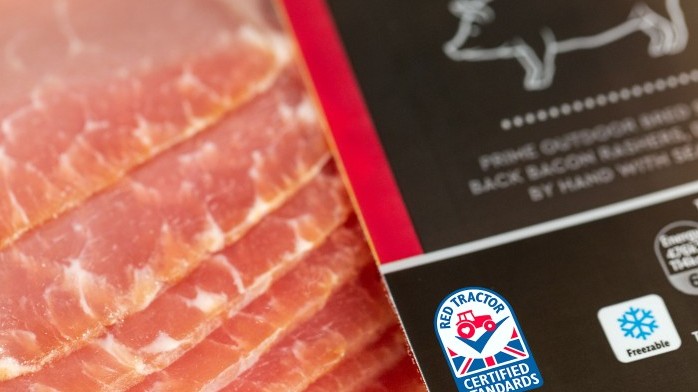
Red Tractor is seeking views on proposed changes to its pigs standards, including the introduction of new standards for flexible farrowing, updated space requirements and measures to address heat stress.
The six-week consultation also sets out changes aimed at delivering more rigorous on-farm biosecurity and improving moving, handling and euthanasia standards.
It says the proposals aims to strengthen welfare and biosecurity requirements and give producers greater clarity on farrowing accommodation.
Flexible farrowing
The new standards would cover flexible or free-farrowing for any farrowing accommodation new builds, expansions or upgrades.
The proposals set a minimum pen size of 6.5sq.m, with a turning circle for the sow of 1.6m. There is a also a requirement for sows to be confined for no more than 24 hours before farrowing and a maximum of seven days after, although Pigs Sector Board chair Stewart Houston said he expected many producers would opt for a shorter confinement period.
Grandfather rights would be granted to early adopters, meaning they would not be penalised if pens ‘don’t quite meet our requirements, in recognition of their leadership and investment’, he added.
Conventional crates remain permitted, but under the proposed changes, new or second-hand conventional farrowing crates could no longer be installed from late 2027.
“Farrowing is a significant investment for any business and producers need a clearer understanding of where the industry is heading,” Mr Houston said.
He added that the introduction of Red Tractor standards would support the industry’s efforts to persuade the government of the merits of a voluntary industry-led approach towards flexible farrowing.
Other key proposed changes include:
- Measures to protect pigs from heat stress, including a new recommendation for cooling measures in indoor pig units, and greater emphasis on the farm’s extreme weather and heat stress plan, including situations it must cover, an annual review and staff being familiar with its contents. rapid response to critical ventilation alarms and a record of incidents and response time.
- Updated space requirements requiring more space for pigs reared to a heavier finishing weight.
- Promoting a stronger culture of care through improved welfare checks, increasing livestock checks from once to twice daily, alongside changes to handling and euthanasia procedures.
- The record of instances of non-permitted euthanasia, where used in an exceptional emergency, has been formalised as a requirement where it was guidance previously. A new requirement for back-up euthanasia equipment is also proposed.
- An annual quantitative biosecurity assessment, based partly on a pig sector project with a Dutch company, BioChek – carried out by the farm’s vet – has been proposed as a recommendation for most, but as a requirement for persistent and high users of antibiotics. There are also new requirements to ensure shower facilities, where provided, are of an acceptable standard.
- It is proposed that the existing requirement for a Wild Animal Control Plan on outdoor units is extended to indoor units.
- The visitor record standard has been strengthened.
Alongside these changes, guidance has been improved to make the standards easier to navigate and understand.
The above changes are part of a wider review of more than 600 requirements that make up the current Pigs Standards, carried out by Red Tractor’s Technical Advisory Committee (TAC), made up of farmers, vets, processors, retailers and technical experts.
Every requirement has been reviewed against defined criteria, with the resulting proposals scrutinised and agreed through consensus by the Pigs Sector Board.
The consultation – which can be viewed here – runs until midnight on December 22. All response must be via Red Tractor’s online portal.
Most of the changes that are agreed will come into force in autumn 2027. The final standards will be published at least three months before implementation, following assessor training, operational updates and UKAS approval.
Feedback
Mr Houston said the proposed changes recognise the need to improve welfare while giving farmers greater clarity. He urged farmers and wider industry stakeholders to review the proposals and provide feedback.
“We want standards that work for farmers and continue to give consumers and the wider supply chain confidence in how British pork is produced,” he said.
“We know this is an exceptionally difficult time for pig producers, and finding time to respond to a consultation isn’t easy. This review started well before the current challenges, and the proposals have been developed with input from across the industry.
“We want farmers to focus on the areas that matter most to their businesses. If something is unclear, difficult to implement or disproportionate, tell us why and what could work better. We’ll carefully consider that feedback before any changes are finalised.”
NPA chief executive Lizzie Wilson welcomed the proposed introduction of standards for flexible farrowing. “Producers have consistently told us they need greater clarity and confidence when planning future investment, and a clear, industry-agreed specification is an important step forward,” she said.
“We support an industry-led approach that delivers continuous improvements in animal welfare while remaining practical, workable and economically sustainable for British pig producers.”
She urged producers and others connected to the industry to respond directly to the consultation and also to let the NPA know of any concerns to help inform its response to the consultation.