



After 10 years of the Electronic Medicine Book, AHDB reported in June that since the register started, we have cut antibiotic use in UK pigs by 72%.
This is excellent news and should be celebrated. However, when the targets were first set, we were aware that meeting them in the first years should be easier than maintaining the downwards trend as the years progressed. It’s the same in pig production – increasing from 10 to 12 piglets weaned per sow is easier than getting from 12 to 13. To keep the momentum going, we must focus on the details.
We do everything we can to make sure our pigs have a healthy and happy life from the moment they are born. But piglets don’t have the easiest start in life.
They are born to a mum who is 200 times bigger than them – and some can be fairly clumsy. The little piglets can’t hang around once they are born.
They need to find their way around the pen or hut from the back of the sow to the udder to make sure they get their share of colostrum before they lose too much body temperature, and they don’t have long before they get chilled.
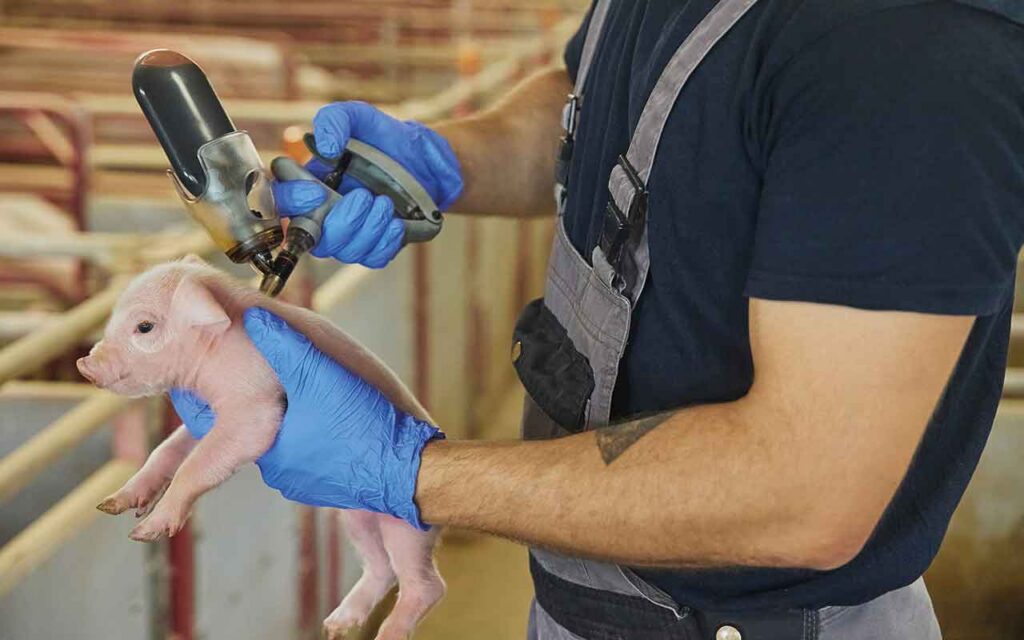
Once they have hopefully settled and latched onto a teat, we often pick them up for processing, which can involve multiple injections and other interventions. Though these are done for good reasons, the interventions probably don’t feel very comfortable for the piglets and potentially open routes for infections.
Some of the interventions at processing are classed as minor surgical procedures. Procedures that in most other animals would be done by a vet or a vet nurse in a surgery or even in a sterile theatre.
Would you feel comfortable if you took your dog or cat to the vet and they rolled out your farrowing house trolley or pulled out the vaccinating guns that sit in the box of your quad? Or if on a visit to your tattoo artist, they tried to use your tattooing pliers or taggers?
Contamination levels
A poster presentation by a German research group displayed at the latest European Symposium of Porcine Health Management showed their results from analysing a sterile solution after flushing it through piglet vaccinating guns before and after vaccination.
Across 10 different piglet-producing farms, 98.8% of samples were contaminated with bacteria and only 6.8% were considered below the legal level for an injectable product. A total of 89.5% of samples contained Clostridium spp and 15.2% S. suis, S. hyicus or haemolytic E. coli.
Farmers and stockpeople have the husbandry skills to carry out piglet processing tasks effectively, but when it comes to hygiene, changing needles is not enough. Joint ill is one of the main reasons for giving an individual antibiotic treatment to a suckling piglet.
Piglets with umbilical hernias are often good pigs that are not suitable to be transported, so cannot be reared to completion, entailing significant loss of revenue. Both conditions can result from an opportunistic infection that happens at or soon after processing.
Everyone on the team should know where, how and how often they should clean and disinfect the processing instruments.
Furthermore, a dedicated wash station is needed (not one that doubles up for washing up the coffee mugs and cereal bowls), along with suitable antiseptic solutions and storage for clean materials (a clean Tupperware box with a lid or Ziplock bags are simple, cheap and dust-proof).
If using a piglet box during processing, a plastic lining that can be changed between litters avoids cross-contamination.
C&D standards
Standards of cleaning and disinfection (C&D) of farrowing rooms is usually very high. My colleague at Garth, Brian Foster, has lately been using an ATP refractometer to objectively measure hygiene in different areas of farrowing rooms after C&D, a technique originally developed for food-producing establishments.
He has found some surfaces are literally clean enough to eat your dinner off, which shows that we do know how to do it, but when it comes to processing, cleaning between batches is not enough.
Piglet processing is important, but piglets are young and vulnerable. So, when asked whether you would let your small animal vet use your farm kit for treating your household pets, the answer needs to be a confident: “Yes!”