




The EU pig population contracted by 0.5% year on year to stand at 131.5 million head at the end of 2025, according to official data from Eurostat, summarised by AHDB. This continues the broader downward trend, with numbers down 10% since 2020.
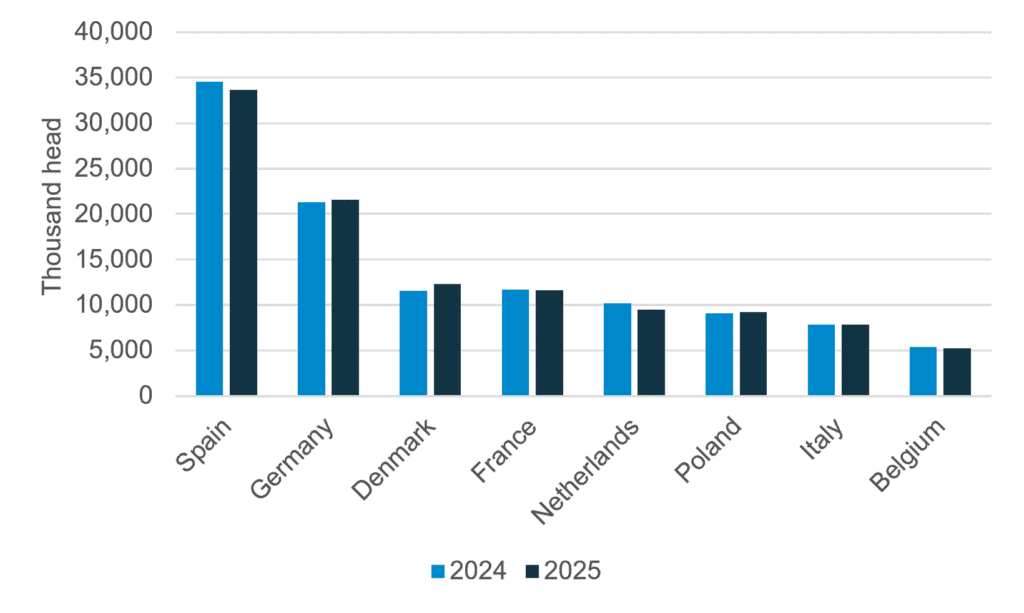
Last year’s decline in 2025 was primarily driven by a 3% reduction in Spain’s pig herd 33.6 million head, down 3% (919,600 head) compared to the previous year, with pig numbers in the Netherlands down 7% to 9.5 million head.
However, several key member states recorded growth – Germany’s pig population increased by 1% to 21.5 million head, while Denmark saw a more notable rise of 6% to 12.3 million head, with Polish pig numbers up 2% to 9.2 million head.
Spain remains the EU’s biggest pig producer, accountingf for 26% of the pig population, followed by Germany, 16%, Denmark and France, both 9%, and Poland, 7%.
Figure 1. EU domestic pig population for selected European Union countries from 2024 to 2025
Source: Eurostat
Breeding sows
The breeding herd showed modest growth, however. Sow numbers totalled 10.3 million head, up 0.8%, although the EU’s breeding numbers remain 13% below 2015 levels. The modest increase may have indicated a temporary pause in destocking rather than a reversal of the longer-term decline, with current market and policy pressures continuing to weigh on the outlook, according to AHDB.
The recent expansion was largely driven by Spain, where breeding sow numbers rose by 3% to 2.7 million head. In contrast, the Netherlands experienced a notable decline, with sow numbers falling by 2% to 786,000 head, as voluntary buy-back programs take effect.
Piglets
Significantly, numbers of piglets under 20kg jumped by 6.1% to 42.4 million head, the highest in the past decade. The increase was heavily concentrated in Denmark, with numbers up 55% to 6.6 million head, probably linked to productivity improvements, including higher piglet numbers per sow and more efficient feed conversion.
Danish live pig exports reached a record 18.5 million head in 2025, up 1% year on year, suggesting that continued export demand may also have supported higher piglet production.
Piglet numbers rose more modestly across most major producers, including Germany (+5%), Poland (+3.4%) and Spain (+1.6%), highlighting improved productivity across the EU’s smaller breeding herd.
Fattening pigs
The number of the heaviest fattening pigs, those of 110kg or over, climbed. by 7.6% to 10.5 million head, 24% up on 2015. Spain accounted for the largest gain, with Germany (−10.3%), Italy (−8.2%) and Belgium (−15.8%) all lower.
The longer trend is more robust, AHDB noted. Pigs of 110kg and over now represent 19.5% of the fattening herd at 50kg and above, up from 14.5% in 2015. The total fattening herd remains 12.3% below its 2020 peak but did not contract in 2025.
UK implications
After several years of tightening supply, EU pigmeat availability appears to be stabilising – the latest EU short-term outlook forecasts production growth of just 0.3% in 2026.
“For the UK, any increase in EU output could create greater competition from imported pork and reduce support for domestic pig prices,” AHDB said.
“The growing concentration of EU breeding capacity in Spain and Denmark could also increasingly shape the origin of future weaner and pigmeat supplies.
“However, proposed regulatory changes in Denmark could have significant implications for its production and export capacity. African swine fever remains a key risk to pig populations and trade across Europe, highlighted by Finland’s first cases in wild boar and two outbreaks on domestic pig farms in Hungary.”