



Few people can bring valuable skills to a pig unit from any previous job, whether in agriculture or an unrelated sector.
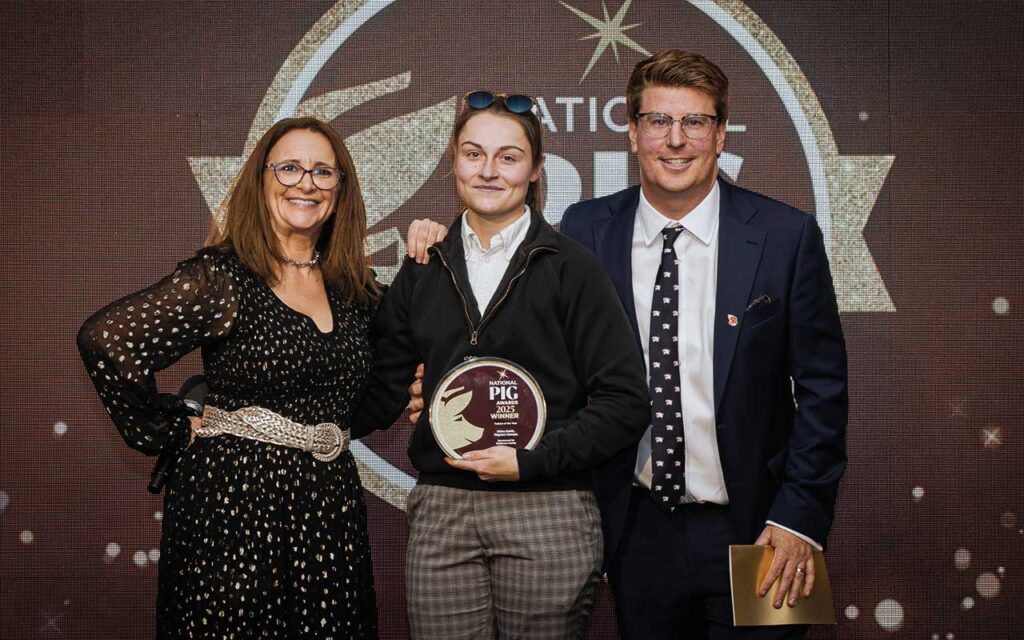
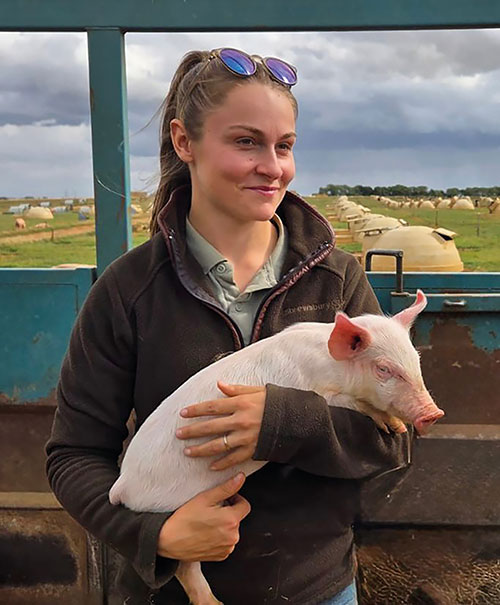
Trainee of the Year Award winner China Smith has thrived in her first pig farming role on a Pilgrim’s Europe outdoor breeding unit in Lincolnshire, having previously worked as a teaching assistant and with no previous experience of farming.
She became a highly deserving pig industry award winner within just 10 months, having not only developed her own skills and those of the wider team, but also driven improvements in farrowing sow feeding and performance, showing great enthusiasm and a strong affinity with the pigs.
China was inspired to get into the industry by her partner, who has been in farming all her life, and threw herself into learning all aspects of the role from colleagues across the unit, picking things up very quickly and showing a great sense of initiative.
In her first six months, China had learned how to confidently operate telehandlers and tractors, reverse trailers and run feeders, as well as all the key aspects of pig husbandry, from serving sows to gilt checks, feeding and vaccinating.
“Everyone here has helped, as and when I’ve needed it,” said China. “I’d never driven a tractor before, but I expressed an interest in feeding the farrowing sows, so a colleague showed me how to.”
To support her hands-on learning, China has taken every opportunity to learn through industry courses.
This includes the required pig moving and handling course and AHDB’s online Stockperson Development Scheme courses on advanced breeding, farrowing and weaning management. China has a great ability to apply her knowledge on farm to help continually improve herd performance.
Farrowing sow feeding
China’s main role is in farrowing management, sharing the work with her manager and assistant manager. They run a closed herd of about 1,000 Landrace sows, producing their own pure Landrace replacements, as well as cross-bred animals, whose progeny go to their other farm as replacements or are sold to other commercial herds.
Feeding and observing the farrowing sows daily, China felt that the feed curve she was following for the group wasn’t quite working for all sows and suggested some adjustments. “I began to feed each sow as an individual rather than feeding them as a collective,” she explains.
“I look at each sow’s condition, record how much feed she has eaten and check what her faeces is like and tailor the amount I feed slightly up or down each day.”
This ensures each sow achieves optimal feed intakes for her individual needs in the run up to farrowing and throughout lactation.
The majority of sows farrow about a week after they are brought into the farrowing paddocks so they have plenty of time to get their bearings and settle in. During those first few days, while the sows are still pregnant, it is really important to monitor their needs, according to China.
“It’s a balance, as you need to make sure they are eating enough, but you don’t want to give them too much and increase the risk of mastitis,” she said.
The results for the sows have been hugely positive, with increased feed intakes leading to good milk production, as well as improved body condition at weaning which, in turn, has led to stronger heats at service and a higher conception rate.
Piglet weaning weight has also improved consistently, averaging 8.2-8.5kg at five weeks old over the course of last summer, and reaching 9.3-9.5kg in the cooler months, driven by China’s dedication and attention to detail.
“Farrowing management is all about knowledge and awareness of the sow,” she said. “If you look after the sow, she can look after the piglets. We could maybe aim for a 10kg weaning weight, but for the breed we have, our current figures are good and the smalls contribute to them, too.”
Digital dry sow records
China also saw an opportunity to improve the recording of dry sow feeding and introduced iPads so the team can input information straight into a single spreadsheet.
It has made it easier to keep track of sow information when animals move between pens and to share it among team members.
“Also, the spreadsheet automatically calculates the feeding rate for us when the number of sows per pen is updated,” she explained. “There’s no scribbling out, so it doesn’t get scruffy and we can easily colour-coordinate information.”
Transferable skills
Based on her own experience, China believes employers should be encouraged to consider giving people a chance who may not have farming or pig farming experience, and that people aiming to get into the industry for the first time should persevere.
“It’s about not giving up,” she said. “If something is easy, it’s often not worth it. Give a reason to potential employers to take you on and just keep trying.
“A person can do any job and take the experience to the next one,” she said. “It’s not just about what they haven’t got, but what they have got – for example, always turning up on time, working hard and being open to learning.”
China’s previous experience in classrooms has proven useful when she is helping to train new team members on the unit.
“Patience is important; I might say ‘take your time’ or ‘I was you once’. There’s no judgement from me,” China added.
“Farming is busy and employers might feel like they haven’t got enough time to train someone new to farming, but it’s not always just a manager’s job to train people, it’s a whole team effort.”
In her experience, the manager might give 10 minutes of guidance on a particular task, while other team members can each spend 10 minutes with the trainee on a range of other tasks, providing short periods of practical learning whenever needed. The end result should be a good, knowledgeable employee who has gathered a broad set of skills from the rest of the team.
Future plans
Keen to expand her experience of farming further, China plans to go and work in a harvest crew this summer, grain carting.
Meanwhile, she is ambitious about her future on the pig unit, and hopes to become more involved in management of the youngest batch of sows, making decisions about which animals to foster on, for example. As a positive, cheerful and supportive member of her team, China looks set to go far in the industry.
Sector-wide review of training and skills
- Establishing a single, easy-to-navigate hub that signposts pig-sector training and career pathways
- Developing clearer progression from entry-level stock roles through to senior technical and leadership position
- Embedding CPD as a normal part of working life in the sector.
