





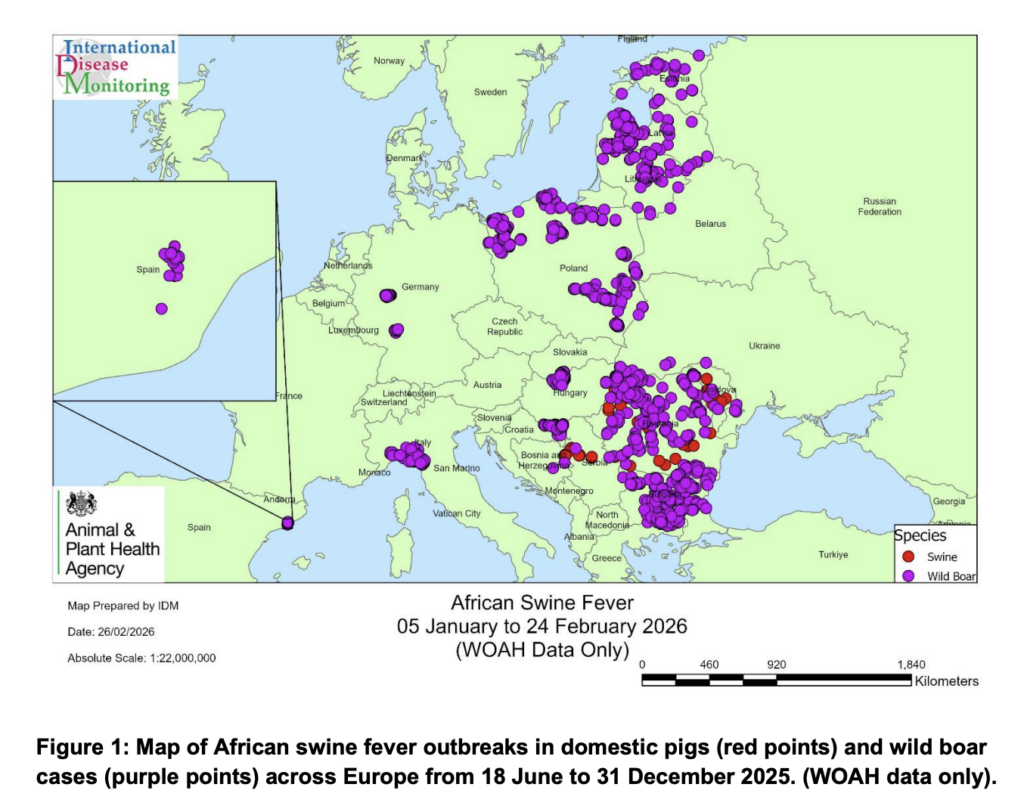
African swine fever (ASF) was found in 16 European countries, which reported nearly 2,000 cases between them from early January to late February, according to the Animal and Plant Health Agency’s latest update.
The biggest developments between January 5 and February have been additional detections in wild boar in Spain in wild boar, with a further expansion in the restriction zone towards the south, and implementation of additional restriction zones and spread west in Germany with the first detections of ASF in wild boar in the
Hochsauerland district, in North Rhine-Westphalia.
According to reports published by the World Organisation for Animal Health (WOAH), additional outbreaks of ASF have been reported in domestic pigs in Bosnia and Herzegovina, Croatia, Latvia, Moldova, Romania, and Serbia.
Additionally, WOAH has reported additional cases of ASF in wild boar across Bosnia and Herzegovina, Bulgaria, Croatia, Estonia, Germany, Greece, Hungary, Italy, Latvia, Lithuania, Moldova, Poland, Romania, Serbia, Spain and Ukraine.
The total number of ASF cases in wild boar in Europe in January to February 24 was 1,871, continuing a recent trend of increased cases in wild boar from 2025 onwards.
However, the number of outbreaks of ASF in domestic pigs across Europe has remained consistent with the lower reports in 2024 and 2025, compared to the peak in 2023. In January and February, there were 64 cases in domestic pigs.
Spanish outbreak
As of February 24, Spain’s ministry of agriculture had reported a total of 162 cases, all in Catalonia. The
most recent update showed detections near Sant Feliu de Llobregat, 7km south of the previous known cases in wild boar, resulting in the restricted zone being extended. No farms have been affected at this time.
Under the new control measures, areas where ASF virus has been detected in wild boar population are subject to ‘Restricted zone II (RZ II) regulations and a RZI zone has been established around the active zone where the virus has not been detected. This new zoning allows for the movement of domestic pigs and wild boar products outside of the restricted zones, which was previously not possible. Control measures as part of the restricted zones include, fencing of affected zones to precent wild boar from moving, 100% sampling of wild boar culled by trained hunters, active searches for carcasses, and pig traps.
EU Veterinary Emergency Teams (EUVET) visited Spain twice, in December and determined that cases likely first started occurring in Spain in October 2025.
The second visit was to investigate the Animal Health Research Centre (Centre de Recerca en Sanitat
Animal (CReSA), following concerns that the virus may have been released from these laboratories. Based on their findings, EUVET could not identify any obvious routes for virus release from the facilities.
German expansion
A total of 80 cases were reported in wild boar in Germany in January and February, largely historical cases from 2025, with 12 reported in Hesse and 68 in North Rhine-Westphalia (68).
The APHA report noted that cases of ASF in wild boar have continued in North Rhine-Westphalia since the first detection in June 2025, including the the first detections in the town of Olpe (18 km from recent reports in Kirchhundem),marking a small expansion westwards.
In better news, on February 5, Saxony was declared free from ASF by the German Ministry of Social Affairs, following no cases in the area for over 12 months.
“The continued rise in cases among wild boar in western Germany, within 70 km of the French border, is concerning. However, the disease has remained largely contained within fenced regions, as the closest reported case to France has held steady at that distance for some time,” the APHA report said.
Other key findings from the report include:
- Italy has reported 189 cases in wild boar in Janauary – 128 in Tuscany, 44 in Liguria, 12 in Emilia- Romagna, 4 in Piemonte and 1 in Lombardi.
- Romania has reported 43 additional outbreaks in domestic pigs.
- Poland has reported 434 cases in wild boar throughout the country.
- There have been a further 202 reports of ASF in wild boar in Hungary.
You can view the full APHA report HERE.
UK risk level
APHA noted that human-mediated spread has been implicated in large geographical jumps previously, and that there could be gradual spread further west through movements of wild boar, if they are not effectively controlled through fencing and culling.
It considers that the risk of entry of ASF virus in live animals and products of animal origin (POAO) from affected countries, remains unchanged at MEDIUM (occurs regularly).
It also warns that: “The potential high risk for non-commercial imports of pork products from ASF affected areas remains of high concern. Evidence from inspections at Great Britain ports suggest that there are vehicles illegally bringing pork meat into Great Britain from some regions of the EU affected by ASF.
Some of these instances involved large quantities of porcine POAO, some of which appear to be home-slaughtered and arrive in Great Britain from an undisclosed origin, as a non-commercial import, with poor levels of biosecurity and food hygiene.
“Therefore, the risk of ASF entering Great Britain, from the human-mediated pathway and moving porcine POAO, is considered to remain at HIGH (occurs very often), though there is considerable uncertainty around this until data is fully collated and analysed, and we will reassess as further information becomes available.”