




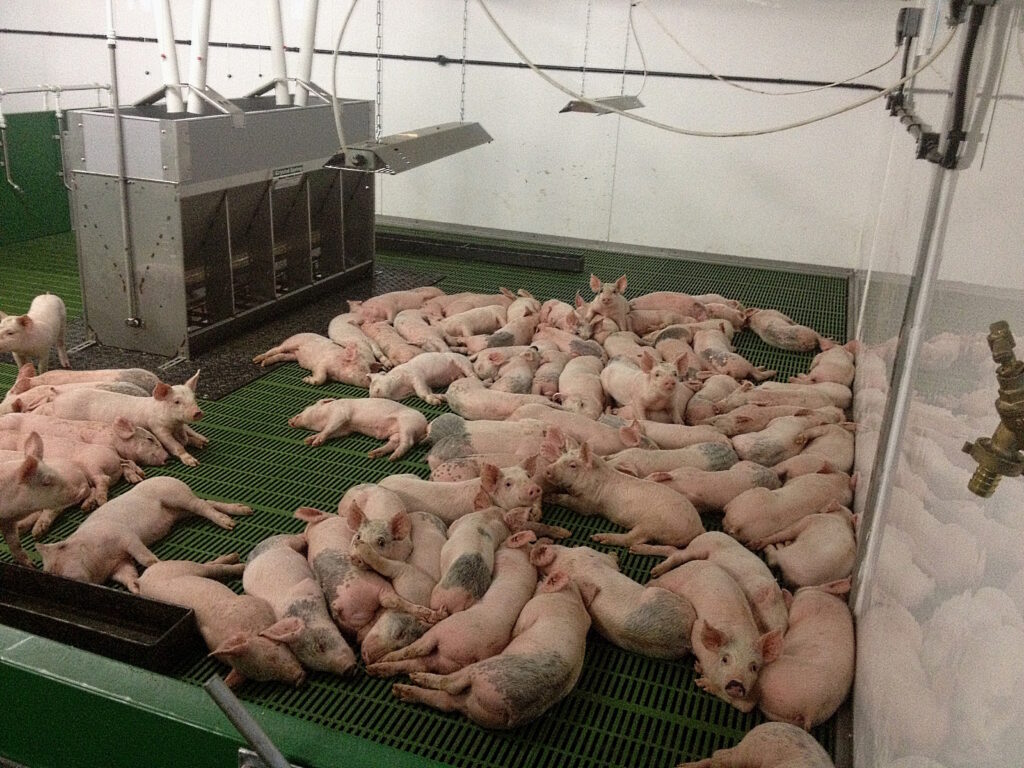
Massive financial savings are available to farmers who monitor key factors in their livestock buildings, alongside substantial productivity, welfare and environmental benefits, according to Hugh Crabtree, director of environmental control specialists Farmex.
Mr Crabtree at the Agri-Innovation Village at the recent Great Yorkshire Show, he outlined how annual savings of £8,887 were made through monitoring heating costs in flat-deck rooms on one pig farm, with the cost per pig produced reduced from £1.27 to just 41p and carbon emissions cut by 55 tonnes.
In another building the kWh electricity use per pig was cut from 10.2 to 3.9 lowering the cost per head from £0.89 to £0.35 – a saving of £0.56 per pig, worth £7,840 per year.
 “Better use of data, particularly in the face of steeply rising costs, should be a priority. The benefits of monitoring key factors – such as temperature, ventilation, feed and water – through sensors in the buildings are well-proven, yet they remain neglected. It is a huge waste of resources,” Mr Crabtree said.
“Although large volumes of data are collected, many farms lack the time and expertise to use it, but a big breakthrough is that AI can now be harnessed for analysis and to generate crucial alerts.”
The UK industry average electricity use per finished pig is 40 kWh per pig, costing £3.52, but in houses supplied by ARM buildings – a company which provides a monitoring facility as standard – the cost is just £1.41 per pig for 16 kWh. “This proves that the on-farm benefits are real – and there for the taking,” said Mr Crabtree.