


At the end of 2025, Defra’s Animal Welfare Strategy was launched with much fanfare and triggered a renewed discussion on farrowing systems.
With Defra’s commitment in the Strategy to move away from confinement systems such as farrowing crates, now is a great time to share industry experience and help steer the conversation.
In late January, AHDB, the NPA and the University of Leeds joined forces to host an online workshop for Defra, APHA and devolved administrations to discuss different options for the transition away from conventional farrowing systems.
The Farrowing Futures workshop aimed to support UK‑wide alignment on the transition by sharing practical, commercial, research and policy insights into free and flexible farrowing systems. The focus was on ensuring that animal welfare, stockperson safety, and real‑world farming practice are properly reflected in emerging policy discussions across the UK.
Five producers who have already adopted flexible or free farrowing systems formed a panel to share their stories and answer questions from the audience. These early adopters presented their insight into the benefits and complications and were uniquely placed to respond to practical and well-informed questions from policymakers.
The situation today
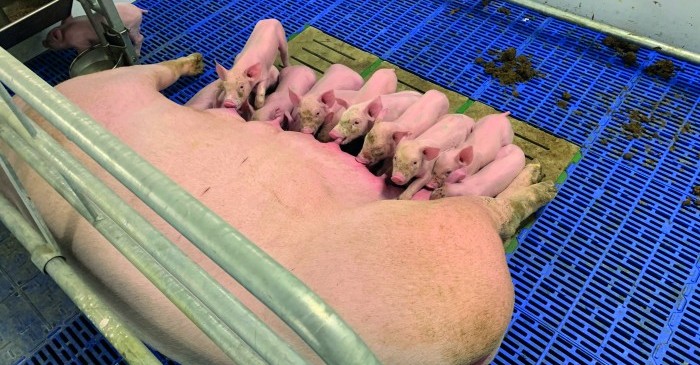
Tim Miller, ARM Buildings’ pig specialist, provided an overview of farrowing systems used across the industry today. In summary:
- The UK pig sector is already transitioning to flexible farrowing without legislation.
- Approximately 5,269 flexible farrowing places already installed, with around 1,800 more places expected in 2026.
- It is estimated that 50,000 to 60,000 indoor farrowing places would need to transition away from conventional crates, nationally.
- Transition requires either new builds or major conversions, often reducing sow numbers per building due to the increased footprint of the flexible pen vs conventional.
National Pig Centre research
Katie McDermott, a researcher and lecturer at the University of Leeds, outlined her recently-published findings from a large commercial-scale study of 666 sows over 12 months.
The study compared the impact on piglet mortality and the lactation performance and welfare of sows across four treatments – farrowing free, confining for 24 hours pre- and two or four days post-farrowing and farrowing free before confining for four days.
The study found that temporary confinement for 24 hours pre-farrowing plus four days post-farrowing was a good alternative to improve sow welfare in an intensive production environment whilst maximising piglet survival.
The highest welfare risk remains in the first 2–3 days post-farrowing and timing and management of crate opening is more important than pen size alone.
Flexible versus Free
It was clear hearing from producers, two of whom have fully free farrowing places on their units, that flexible systems are currently viewed as the only model that balances protecting piglet survival in the highest-risk early days and maintaining staff safety and operational practicality, while allowing sows to adapt their behaviours for improved welfare and even delivering on health.
Fully free farrowing, while welfare-positive for sows, also presented widely recognised concerns, including by those who used them. While they might be viable in niche or specialist systems, higher piglet mortality is seen when used at commercial scale, and the systems are more costly in labour and infrastructure.
The big barriers
As anticipated, producers spoke at length about the costs and planning difficulties they had faced when installing flexible systems.
Supported by Tim Miller, the level of investment required was made clear. For a new building, current prices are around £6,000-£7,000 per sow place, and even conversion within existing buildings is approximately £2500 per sow place.
This does not account for reduced sow numbers, which is inevitable with more space required per sow, and therefore units will either need to reduce sow numbers, with the associated loss of income, or build additional buildings to maintain numbers.
You can see more on the economics of the swich to flexible farrowing in this AHDB document, published last year: AHDB The economics of flexible farrowing report February 2025
This led us on to the next big problem, which is planning. Planning consent alone often takes over 12 months and costs tens of thousands of pounds, and in any case there is limited availability of specialist builders, and lengthy equipment delivery times. Therefore, the current industry consensus is that it would be impossible for every unit to transition in anything less than 10-15 years.
Producers were keen to highlight that producer willingness is not the primary constraint, but affordability, planning and capacity could present major stumbling blocks.
Producer wish list for policymakers
Throughout the workshop, certain asks of industry were clearly made to Defra. As industry representatives, the NPA and AHDB also support these asks. The NPA has been lobbying Defra for the past two years, and will continue to do so – however, it is hugely beneficial for policymakers to hear directly from producers.
Producers asked for:
- A long, clearly signposted transition period (10–15 years minimum)
- No retrospective penalising of early adopters
- Stable policy direction (no repeated shifts in requirements)
- Guidance on pen dimensions
- Recognition of investment needs, planning delays, staff safety and animal welfare trade-offs, consideration of import standards to avoid displacing welfare impacts overseas.
Defra’s Animal Welfare Strategy highlights the desire to consult the industry on the transition, and conversations with officials and comments from the Minister have certainly supported that claim.
Engagement on this topic so far has been excellent, with policymakers showing genuine curiosity and desire to understand all the details before any policy proposals are made.
The Farrowing Futures workshop built on this, providing a space for open and constructive dialogue which we look forward to continuing.
