




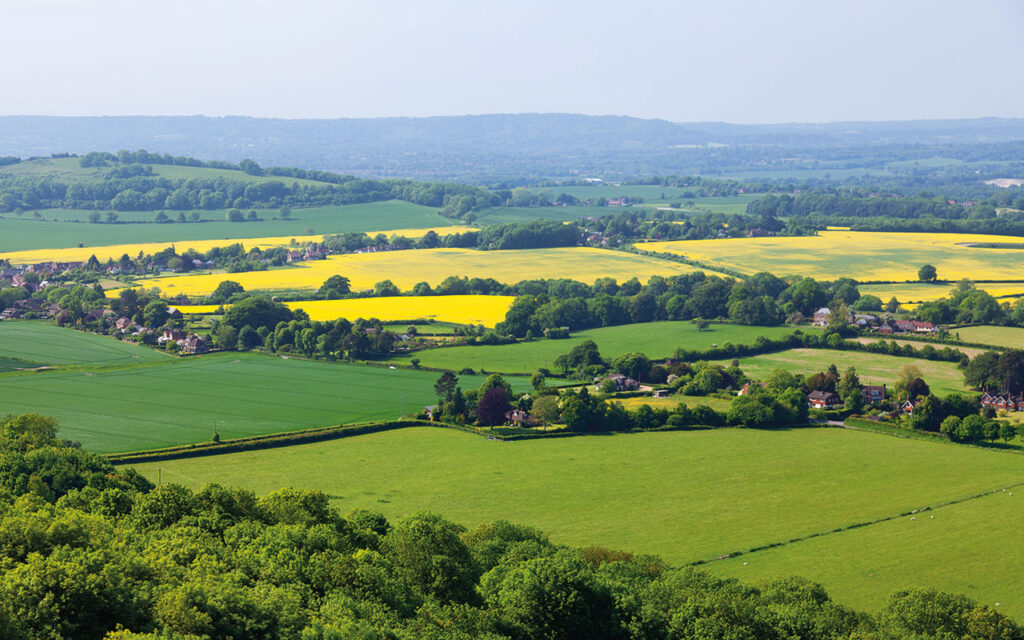
The government has pledged to help farmers ‘maintain overall food production in England to underpin our future food security and drive economic growth’, as it publishes the first ever Land Use Framework.
The Framework is a plan for delivering new homes, nature restoration, clean energy and food security, which the government says demonstrates clearly that there is enough land to deliver the government’s objectives ‘provided we use land more efficiently and for multiple benefits’.
Based on ‘the most advanced land use analysis ever undertaken’, the Framework will aim to support food security and national resilience, making a clear, long-term commitment to maintaining food production in England, while ‘supporting farmers to diversify and remain profitable in the face of extreme weather and market shocks.
It sets out how incentives will be optimised to deliver for nature and resilient food production. To support farmers and food security, the LUF sets out plans to:
- Maintain overall food production in England to underpin our future food security and
drive economic growth. - Publish updated land classification data and mapping that safeguards our best
farmland for food production, with impacts of land use change on food security monitored
through the UK Food Security Reports. - Develop sector growth plans, beginning with horticulture and poultry, to help improve
productivity, profitability and resilience. - Bolster support for tenant farmers by reforming the Farm Tenancy Forum to give them a
greater role in policy making. - Simplify payment systems and digitise land data submissions to make it easier for
farmers to work with Government on land use. - Encourage farmers to explore multifunctional land use by providing up to £50m for
trialling the sustainable management lowland peat soils. - Launch a new Farmer Collaboration Fund with up to £30m for collaboration between
farmers to support land use change activity.
Vital but finite asset
Defra Secretary Emma Reynolds said: “Our land is a vital national asset, but it is finite. We cannot be held back by the false choices between building homes and producing food, restoring nature and supporting farmers, or delivering clean energy and protecting landscapes.
“With better data, smarter tools and strategic planning, we can meet all these needs. This ensures people can manage their land in the way that works best for them while unlocking growth, strengthening food security and protecting our environment.”
Energy Secretary Ed Miliband said: “We are ensuring that the countryside continues to feed the nation, while delivering the clean homegrown power that we need to protect household energy bills from volatile fossil fuel markets.”
Planning reforms
The Framework will provide the principles, advanced data and tools for national and local government, landowners, and developers to make the right decisions to meet the demands of the land.
Housing Secretary Steve Reed said: “We’ve been clear from the outset that our planning reforms will achieve a win-win for both housebuilding and nature recovery. The first of its kind in England, this Framework will ensure we make smarter decisions on land used to build the homes and infrastructure we need, while protecting and enhancing our natural environment and wildlife.”
Industry reaction
NFU President Tom Bradshaw said: “It’s positive to see an explicit recognition of multifunctional land use and a commitment to maintain food production within the framework. This commitment, alongside the repetition from Defra that food security is national security, is vital as the global geopolitical situation continues to become more uncertain with the war in the Middle East and ongoing war in Ukraine.
“The Land Use Framework is a step in the right direction, but challenges remain about delivering against the ambitious objectives as the first 2030 milestone approaches. Delivering on all objectives with existing land is an ambitious aim and will require clear guidance, the right policy framework and incentives, to avoid unintended outcomes and ensure that all farmers and growers are able to meet the ambitious productivity objectives within the framework.”
The EFRA Committee responded to the publication of the framework by launching a long-term thematic inquiry into land use and nature in England, as a new component of its Strategy.
EFRA committee chair Alistair Carmichael said: “The Government has set ambitious targets to conserve ecosystems, build hundreds of thousands more homes and new renewable energy sources, and to expand the National Grid. Given that around 70% of England’s land is agricultural, it is farmers and growers – already under pressure – that are most likely to be impacted by these priorities.
“Squaring all of the above will be a tricky balancing act that requires detailed, thought-through policy. In many cases there could be winners and losers, and we know these subjects can be potent at stirring up emotions.”