

Four German farming industry bodies are calling for the government to provide €200m a year in targeted support for producers who convert to higher welfare pig breeding systems.
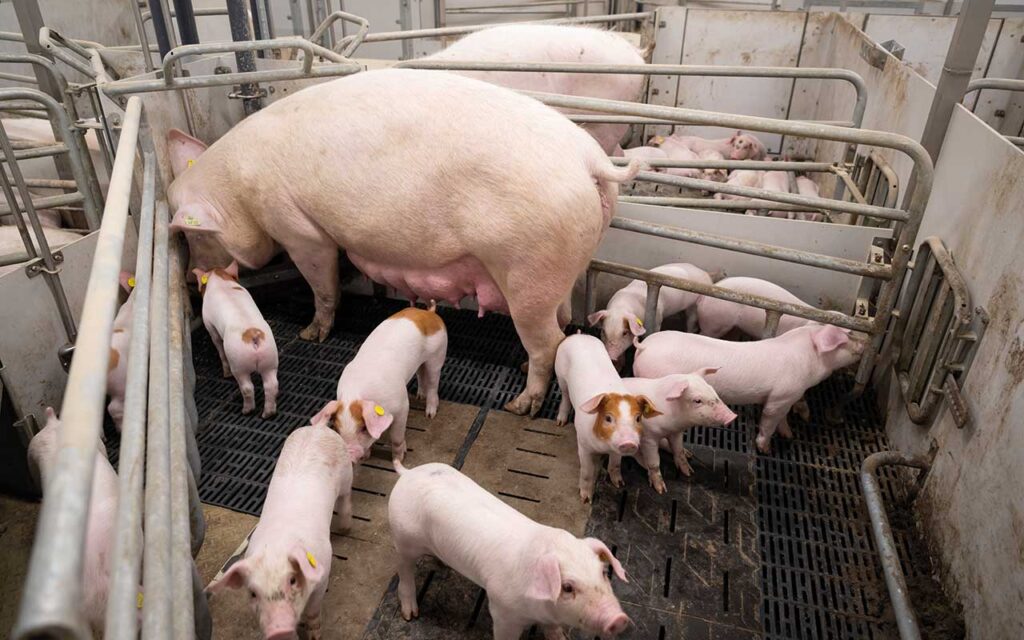
Under legislation introduced in 2020, breeding units in Germany are required to convert to full group housing with at least 5 m² of space per sow by February 9, 2029.
In farrowing areas, from February 9, 2036, free-range pens – more widely referred to as flexible farrowing pens – with a minimum area of 6.5 m² and a maximum confinement period of five days will be mandatory. Both requirements significantly exceed the requirements of other major European pig producing nations.
The German Cattle and Pig Breeders’ Association (BRS), the German Farmers’ Association (DBV), the German Raiffeisen Association (DRV), and the ISN (German Pig Producers’ Association) have called for a ‘national special programme for sow husbandry’, according to various reports.
The warn that without targeted financial support, the move could result in a dramatic structural change and the loss of significant parts of German piglet production, Euromeat News reports.
The industry estimates that approximately €4,000 investment will be required per sow without any increase in revenue to compensate for it. Medium-sized farms therefore face individual investments of approximately €1.5 million – without any prospect of increased revenue or efficiency gains.
The organisations also warn that implementing the changes will often force farmers to reducr the herd size, given the extra space requirements, which they say directly contradicts the government’s goal of food security. Without support, piglet production risks migrating abroad, they say.
The four associations are calling for a unified national programme that includes the following core elements:
- Access for all pig farmers: Regardless of company type, income, stocking density and size restrictions, with no upper limit on the number of existing buildings. An expansion of the existing building stock must not be excluded when claiming funding.
- €200 million annually until 2036: With the option of carrying over remaining annual budgets to subsequent years.
- Funding rate of approximately 50%: With the option of tiered rates depending on the investment volume.
- Simple application process: A low-bureaucracy procedure that can also be implemented at short notice.
They say the purpose of funding is structural preservation of the industry and with no further additional requirements; flexible implementation of individual husbandry areas is possible. However, without a special program, structural collapse of the sector is ‘imminent’, they warn.
The four associations stressed that a patchwork of different state subsidies would be ineffective. “Only a national special programme ensures planning certainty and prevents Germany’s go-it-alone approach to animal welfare requirements from driving a massive structural break in sow farming,” they say.