



There was only one big talking point at this week’s British Pig and Poultry Fair – the move by the big pork players to cut back on their independent pig suppliers.
Producers across the country have been given notice by processors over the past few months, typically coming into effect in six or 12 months’ time. In some cases, producers are being dropped altogether, while in others, numbers are being reduced.
The pre-event talking point was the recent dramatic cuts made by Morrison’s abattoir Woodheads, amounting to thousands of pigs a week. The company blamed the ‘challenging economic climate’.
But it became clear at the event that all the big pig processors, including Pilgrim’s UK, Cranswick and Sofina Foods, have given notice to some of their suppliers over the past few months.
The backdrop is an oversupply of pigs versus flat demand, resulting in significant backlogs on farms, which were also partly driven by a series of factory issues in the autumn. This has coincided with a period of falling EU prices, adding to the downward pressure on the UK market – and rising costs, as a result of war in the Middle East.
It has also coincided with the build-up to the August 13 deadline for the introduction of the Fair Dealing Obligation (FDO) regulation’s requirement for all pig contracts to be in writing, with certain conditions specified, leading some to question whether processors are ‘wiping the slate clean’ ahead of this deadline.
Speaking to producers at the event, it was very evident that different people are in very different positions. Some, who have lost contracts with little immediate prospect of finding a home elsewhere and/or are trying to cope with backlogs, rock bottom prices and rising costs, are considering their future in the sector. For some, the current situation is as bad as they experienced in 2021 and 2022.
Others, depending on their supply and contract arrangements, report being relatively unscathed. Many are somewhere in between, with some describing as the situation as ‘very difficult’, but nothing the sector hasn’t seen and endured before. “You’ve just got to get on with it,” one said.
While the mood at the event was, overall, relatively downbeat, especially compared with the optimism of 2024, numbers held up and standholders reported good trade and a lot of interest in their products.
But four years on from the biggest crisis the pig sector has ever endured, current events have, yet again, raised questions about the long-term viability of the independent sector versus the growing integrated pig herd.
Outlook forums
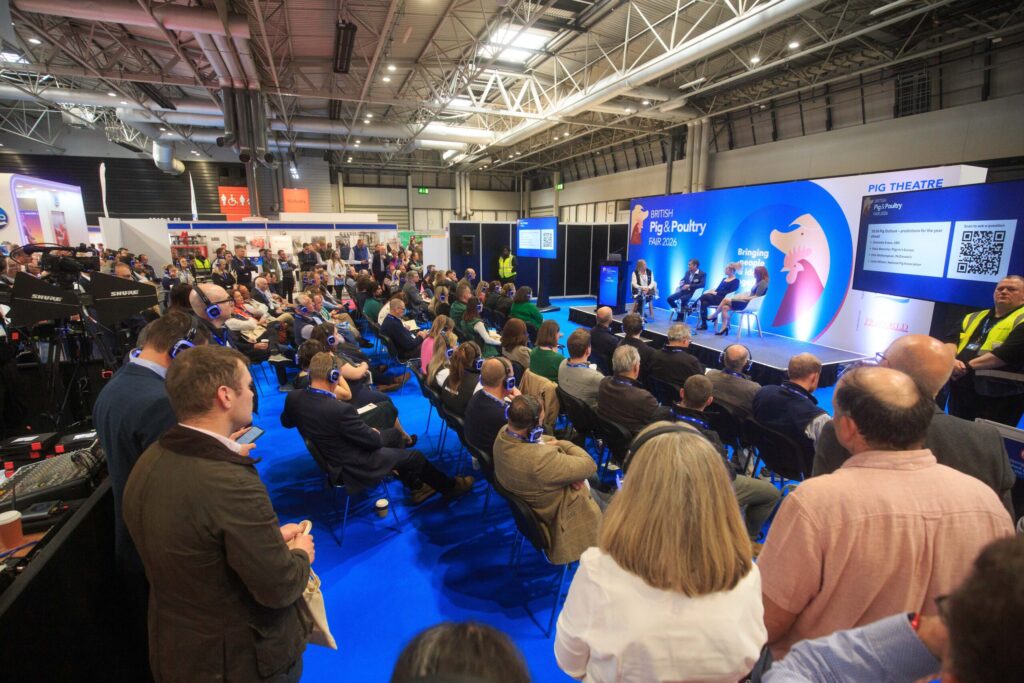
The market situation dominated discussion at the BPPF Outlook Forums, featuring Pilgrim’s Europe’s operations director agriculture Fabio Brancher, NPA chief executive Lizzie Wilson and Ellie Wotherspoon, McDonald’s agriculture and sustainable sourcing manager.
Discussing the numerous examples of producers being given notice by processors, Ms Wilson said it was impossible to gauge how it will play out in six month’s time when the contract decisions start to take effect.
“Will supply have tightened enough and will demand have gone up enough? We may have lost some producers and others may have reduced herd size. It might be that, actually, some of these contracts will be renewed, and we’ll find ourselves in a better position – or will it be carnage?
“I really don’t know. It has been an unfortunate sequence of events, especially with this August deadline coming up with regards to contractual practice.
“So, I’d say to producers, ensure that your processors are contacting you with regards to your contract because it needs to be reviewed and negotiated by that August deadline. I know that that isn’t great timing at the moment, but they are legally obliged to do that.”
She urged any producers to who have concerns to contact the Agricultural Supply Chain Adjudicator, who was at the show on Wednesday and wants to hear from producers who have issues with their pig contracts.
Reducing the backlog
Mr Brancher set out what Pilgrim’s has been doing to address the problem, including putting on nine extra Saturday kills and, in the past fortnight or so, killing for an extra 30 minutes each day. He said the company slaughtered a record 48,000 pigs in its abattoirs last week, compared with a typical 43,000 head.
“We are trying to reduce this backlog,” he said. “We are doing a good job together with the farmers, not only our internal farmers, but also the third-party farmers from the marketing company, to try to mitigate this issue.
“We are trying to hold more pigs on our farms to reduce the problem for the third parties and to put more pigs in our abattoirs.”
Stressing that it was an industry-wide problem, he highlighted the impact of low European prices and ‘too many pigs’ being in the system, after producers across the sector increased sow numbers. He said Pilgrim’s factory problem in the autumn was not a breakdown, but ‘an investment that didn’t work very well’ that resulted in a two-week hiatus at the plant, adding that it had not experienced any factory issues for a number of months.
He said the current situation was ‘not good for the British industry’. “I totally understand – it is not good for farmers, it is not good for us and it’s not good for the customers. He said Pilgrim’s was putting carcases in stores and sometimes selling some of the pigmeat for low prices.
He said he could not promise that the backlog will be resolved ‘fast’, but predicted Pilgrim’s will be able to address it ‘in a few months’.
The company is working hard to ensure all contracts are compliant with the regulation by the August 13 deadline, with ‘92 to 93%’ of the company’s third-party farmers having signed the new contract. “We have had a discussion with our legal and compliance team to put our everything in place to be fair to the contractor, to us and for the farmer,” he said.
- You can view the forums from BPPF 2026 HERE