



Fresh concerns have been raised about the UK’s border controls, after it emerged that products from a company in Vietnam at the centre of a scandal involving meat infected with African swine fever (ASF) have recently been on sale in the UK.
Media reports in Vietnam revealed that the CEO of Ha Long Canned Food JSC (Halong Canfoco) has been charged with ‘negligence causing serious consequences’, after it was discovered that the company had used pork that tested positive for the ASF virus in its canned pâté.
The case reportedly came to light after Vietnam’s Ministry of Public Security’s ‘economic police’ detected two trucks transporting 1.2 tonnes of pork of unknown origin last September. The consignment later tested positive for ASF, which has been circulating in the country this year, according to VN Express International.
Investigators found a further 130 tonnes of frozen diseased pork stored at the company’s warehouse. They said the company had made more than 1.7 tonnes of pâté, equivalent to about 14,000 cans, using contaminated raw materials on September 6 and 7.
Other products, including 4,000kg of spring rolls and 3,000kg of premium spring rolls, also tested positive for ASF, while investigators found that 13,000kg of frozen pork skin and 8,000kg of frozen chicken skin were contaminated with salmonella.
UK sale
 Despite these hugely damaging findings dating back to the autumn, it has emerged that products from the company have been on sale in the UK, at least until a few weeks ago.
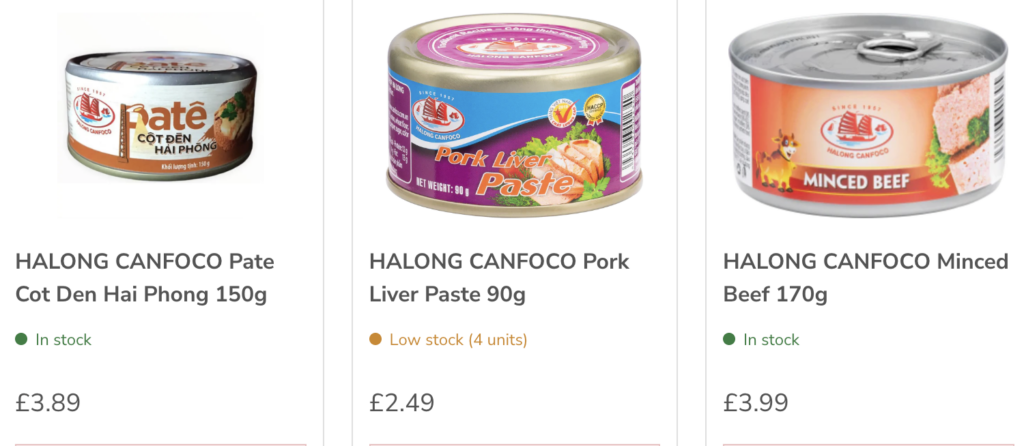
A simple Google search showed that Ha Long canned pâté, pork liver paste and slices of pork were available in the UK via Huong Viet Asian Supermarket.
After being contacted by Pig World, a spokesperson for the company said: “Since the news broke, we have removed all their products off our shelves and online.”
They said they learned about the case ‘via Vietnamese media, roughly three weeks ago’ and decided to remove the products, as a result.
There is no suggestion that Huong Viet Asian Supermarket has done anything wrong, and its decision to remove the products has been welcomed. However, the fact that these products have very recently been available in the UK – so soon after the discovery of the immensely dangerous nature of some of the ingredients the was manufacturer was using – has generated alarm and raised further questions about our border controls.
Leaving biosecurity to chance
Tony Goodger, the Association of Independent Meat Suppliers’ head of marketing & communications, discovered a few days ago that products from the company were seemingly available in the UK and immediately passed the information onto the Food Standards Agency (FSA).
But he said it was concerning that the UK authorities appeared to have no prior knowledge of this potentially catastrophic situation.
“It appears that we are leaving the country’s biosecurity to chance,” Mr Goodger said. “It was fortunate that the store saw it on Vietnamese news and also took proactive action to remove it from his shelves.
“And it was by pure luck that I spotted the issue, and it was then only my own investigations which identified the products being available in Asian supermarkets.
“At present, we have no idea about the full range of potentially contaminated products in the UK, for how long they have been sold to consumers, their batch codes or where else they might be being sold.
“This highlights that the UK must have better surveillance/horizon scanning at local level in countries whose products may be exported to the UK. We need to be better, quicker, and smarter with biosecurity information.
“Immediate action is needed now to identify where these products are, and we need the British Embassy staff horizon scanning and reporting on incidents and a clear chain of communication back to the UK as an alert.
“If these threats to our country’s farms and to consumer health are flagged at source, the appropriate action can be taken to seize the products, ideally at the point of entry.”
FSA/Defra response
An FSA spokesperson said: “We’re aware of the issue and we’ll share with relevant authorities, so together we can evaluate this and provide appropriate follow-up action if required.
“We are committed to responding to claims of food fraud and continue to work with local authorities to help food businesses meet their responsibilities to sell meat that’s safe and authentic and to protect the consumer.”
Defra said it could not comment on this specific situation but provided some ‘background’, including:
- Vietnam is not authorised to export fresh or heat treated pork to GB.
- It does not have an approved residue control plan for porcine, which is a requirement for human consumption.
- All consignments of meat products must enter Great Britain through a Border Control Post (BCP) where checks are carried out to ensure that import conditions have been met.
- The consignments need to be pre notified to the BCPs at least one working day in advance.
NPA reaction
NPA chief executive Lizzie Wilson said the incident raised many important questions. “It is very well documented that previous major disease outbreaks in the UK and, recently, across Europe are often linked to domestic or feral pigs gaining access to infected meat brought in from another country,” she said.
“The risk is the same whether that meat is imported via legal or illegal routes – and it is hugely worrying that products from a company that has only recently been found to have been using ASF-infected meat have been available in the UK.
“What makes this worse is that the authorities appear to have been completely oblivious. We need to know how widely and for how long these products have been sold in the UK – and whether potentially infected meat is still available.
“We share AIMs’ calls for the government to step up its international intelligence gathering and communication to help ensure this cannot happen again.
“This is yet another example of why the government must not row back on resource or wider commitments to border controls under a future UK-EU SPS agreement.”