



Up until recently, Alice and Bob were unknown, other than to the techies behind the scenes at Facebook.
Then Alice and Bob were asked to have a chat with each other and to trade balls, books and hats. Very shortly afterwards, Alice and Bob had converted comprehensible English into a shorthand that only they understood, which allowed them to carry out their trades of balls, books and hats far quicker.
Bob and Alice are robots, though not the type that we see pressure-washing pig units (only in Holland, of course, or maybe, Denmark). Instead, they are computer-based robots that use artificial intelligence to process unprecedented amounts of data in order to have lifelike conversations with humans.
During the discussion at June’s Pigs 2022 conference about real-time, in-pen weighing systems that measure pig performance as it occurs, attendees asked: “What can we do with the data?” and “Who do we give this data to?”
A nutritionist or vet might be able to help make use of it but, bearing in mind some of these weighing systems produce 5,000 readings per day, per pen, how can we process it all usefully? How do we know what’s normal for our unit? And, more importantly, how can we determine if something isn’t normal? This is where the robots come in.
“The advantage of using a suitable machine learning platform for analysing data is that it doesn’t take a computer wizard or statistician to build tools that can help make real business decisions.”
Machines’ ability to ‘learn’ and develop artificial intelligence is developing at great pace worldwide, and there is no reason farming should be left behind.
Indeed, in China, a ‘Dr Pig’ app takes previous market data and helps to predict the future profit and loss of certain types of pigs sold into certain types of markets at theoretical points in the future. This enables smarter business decisions to be made back in the real world, by people in Wellingtons with smartphones.
To animal scientists, mathematical modelling of real-world situations in order to drive certain outcomes is nothing new. But, if a farmer uses new precision technology to gather performance data, they need an easy way to analyse it.
The recent launch of the ‘machine learning’ platforms from companies such as Microsoft, Google and Amazon has gifted the idea to the masses, as it automatically does all the complex modelling a scientist would normally do. And, in certain forms, it’s free to use!
The advantage of using a suitable machine learning platform for analysing data is that it doesn’t take a computer wizard or statistician to build tools that can help make real business decisions. A user can enter their data (by uploading a spreadsheet, for example) then follow a simple process on screen to set their chosen parameters for a ‘model’ and ask the platform to run multiple versions of it until it finds one it is happy with.
For example, I have taken 740 individual pig records from the AHDB Pork Focus Farm and fed these into one such platform to create a model that will predict the week of kill – as the Focus Farm only sends pigs once a week.
The ‘robot’ uses 703 of the records (95%), which include birth date, birthweight, sow ID, parity and piglet gender, to ‘train’ itself to predict the week of kill. Once it has established a ‘best model’, it then tests itself using the other 37 records (5%).
The week of kill predictions I was able to make using the final model was accurate to an average of around one week. Of course, in reality, I haven’t predicted anything. The robot has looked at the data I provided, tried out 10,000 different versions of a particular algorithm and has provided me with the best model for the job.
The resulting model can then be published online, allowing the user to enter different data in certain fields to make predictions.
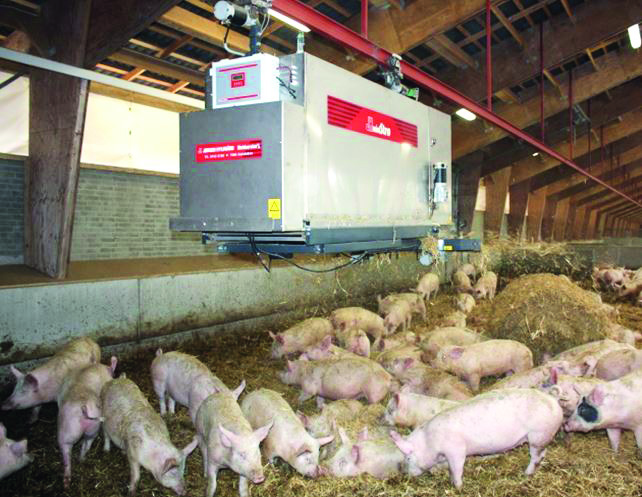
From cloning pigs in China, delivering straw or feed to pens of pigs on the continent, through to processing pig carcases post-slaughter here in the UK, robots are being used throughout pig production and processing chains worldwide.
AHDB is making its first forays into robotic machine learning and steps towards artificial intelligence – led by its in-house development team.
Recently, the team took more than 300 high-resolution images of a beef carcase in an abattoir to create a 3D model to be used with virtual reality headsets for training and other applications. Normally, it would take several days, if not weeks, to turn the photos into a model by creating wireframes and wrapping the photos around them – not to mention the immense computing power this would take. Instead, the photos were dropped into a computer aided design programme, which has a remote machine learning facility, and ‘sent off’ to be processed. Just 20 minutes later, the team had a high-resolution image of a beef carcase.
We are seeing pig buildings becoming more and more intelligent, with water meters almost a given in many cases, while the availability of CO2 and NH3 sensors is also increasing – not to mention our real-time weighing technology.
AHDB could provide machine learning models (and the automated link into them) that would allow buildings manufacturers to feed the data from their computers into an intelligent model to help analyse the data. This could then provide early warning systems or even to help optimise the running of the buildings, in terms of production efficiency, water consumption, power use and many other factors.
The inputs and predictions these models can make are limited by one thing alone: whether there is an actual link between the data. For example, birthweight is truly correlated with days to bacon. Provided the data used to train the model has these genuine links, the model can then predict an outcome.
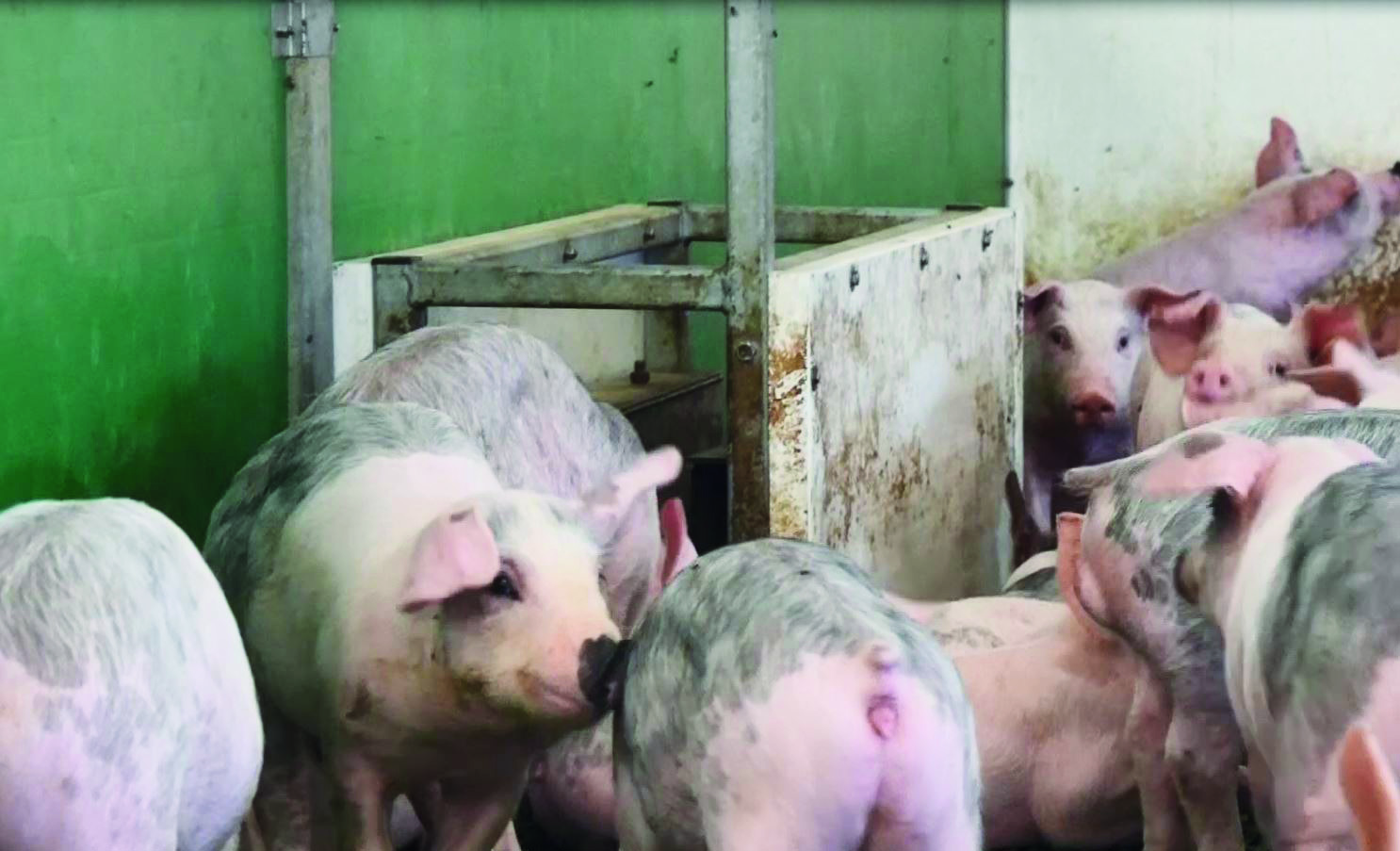
Essentially, we can have our in-pen weigher, buildings and various other gadgets and our staff putting data into a suitable model on an ongoing basis (yes there is still a person looking at pigs every now and again in this futuristic world). At the same time, the model is learning and evolving as it gets to know what’s normal for our units and our pigs. 
And, excitingly, once it’s learnt what’s normal, it can tell us very quickly when something isn’t. For example, assuming pigs were individually identified, if a pig lost a bit of weight for a few days, the model could tell us whether the weight loss was ‘normal’ – because it was warm, or agitated or we’d just changed its feed – or whether it was an issue to be looked into, because it was ill or for some other reason.
Machine learning models may be something some producers want to try building themselves, but equally, vets, nutritionists, genetics companies or equipment manufacturers could investigate them and build models for producers to load data onto. These models can be accessed via smartphones, as the actual processing power is in the ‘cloud’.
They can continue to be ‘trained’ by a certain proportion of real data being inputted, either automatically by equipment that uses the model or manually by the keepers of the models themselves.
It is not all that straightforward, though. Something this very powerful tool has taught me is that until we start being able to monitor pig performance on an individual pig basis, we will only be able to make very limited use of the technology that’s becoming available to us.
Perhaps it’s time to get out of science and buy shares in an ear tag company…
