


The long-awaited Pork Environmental Roadmap is an important and potentially hugely valuable ongoing piece of work for the British pig sector.
Another prime example of pig sector collaboration, it has been developed by an industry-led steering group, facilitated by AHDB, over a long period, built on hard evidence from a range of sources.
At a time when the industry is craving a bit of good news, it highlights impressive progress made by the industry in improving its environmental footprint – and how it compares well on a global pork sector level and with competing proteins.
In doing so, it provides the sector with a credible tool to defend and promote what it does. Perhaps most significantly, it sets out a pathway for continued improvement.
“This roadmap helps the sector stay in control of its own story,” said Hugh Crabtree, chair of the Pork Environmental Roadmap Steering Group.
In 2024, UK agriculture contributed 12% of the country’s greenhouse gas (GHG). The pork sector accounts for 4% of total UK agriculture emissions, primarily driven by nitrous oxide from feed production and fertiliser use, alongside nitrous oxide and methane from manure management.
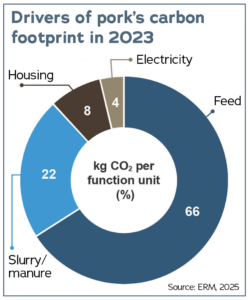 At farm level, four main drivers influence emissions (see graph, right) – feed (66%), slurry/manure (22%), housing (8%) and electricity (4%).
The roadmap provides a single framework structured around seven strategic priorities:
- Net carbon
- Air quality
- Water stewardship
- Slurry, manure and nutrient management
- Biodiversity
- Waste and recycling
- On-farm energy.
Supporters
The organisations and individuals that have supported the roadmap:
- AIMS
- British Meat Processors Association
- Cameron Naughton
- Cranswick
- David Black & Sons
- Hugh Crabtree
- National Pig Association
- Nick Major (independent)
- Pilgrim’s Europe
- Quality Meat Scotland
- Red Tractor
- Sofina
- Tom Allen
Lifecycle assessment
The evidence gathered shows that British pork production has already made significant, albeit uneven, gains over 15 years.
Progress was primarily measured by comparing life cycle assessments (LCA) every five years from 2008 and 2023.
LCAs provide a detailed picture of how different stages of production (feed, housing, manure management, energy use and land-use decisions) contribute to environmental impact.
The headline was an 18% decline in total climate change footprint, from 3.88kg carbon dioxide equivalent (CO2e) in 2008 to 3.2kg CO2e in 2023.
Much of the improvement is accredited to productivity gains, including increased litter sizes, higher carcase weights, faster growth rates and improved feed conversion efficiency – enabling more pork to be produced per unit of input, reducing ‘emissions intensity’ across the system.
A major contributor has been a 71% reduction in emissions associated with land use and land-use change since 2008, including a ‘substantial and sustained decline’ through 2018 and 2023.
This has been driven primarily by changes in feed sourcing and formulation. Advances in genetics and herd health, more efficient housing and ventilation, improved manure management and improved on-farm energy efficiency have delivered incremental benefits.
Other gains are more modest. There was a 3% reduction in freshwater eutrophication (accumulation of nutrients) and a 13% fall in terrestrial eutrophication, while acidification decreased by 11%, reflecting sustained improvements in nutrient and emissions management.
Fossil resource use declined by 12%, reflecting improvements in energy efficiency across feed production, processing and on-farm operations.
However, use of minerals and metals increased by 18%, primarily driven by changes in feed composition over time.
Water use was up by 5% between 2008 and 2023, linked to shifts in feed composition and the geographic sourcing of key ingredients.
Farmer view – a ‘massive step forward’

The roadmap steering group included two farmers, indoor producer Tom Allen and outdoor producer Cameron Naughton.
During the launch, Mr Naughton described the roadmap as a ‘massive step forward’ and urged fellow producers to engage with it. “It means we can quantify with confidence and science-based arguments, some of the more knee-jerk headlines we’re seeing at the moment,” he said.
He outlined some of the sustainable approaches adopted on his Wiltshire unit. “We’ve been liquid feeding for the past 30 years. We use yoghurt and yeast, which has reduced the amount of imported soya used in the finishing pigs by roughly 50%.
“We also grow peas and we operate a very circular economy with neighbours. We grow a lot of arable ourselves, but use a huge amount of their straw, and they are desperate for manure.
“We’ve been putting pigs out onto grass for the past 20 years in an attempt to help the soil structure, and we’ve been using grass margins to prevent run-off long before they became fashionable.
“A lot of it simply makes good business and operating sense, while also helping massively with the environment.
“As farmers, we have to acknowledge where we could do better. But all producers are doing good things, looking after the environment in which we live and work, but we’re maybe not sharing that.”
He said the roadmap will help producers show customers the improvements that have been made and, more importantly, the commitment to further progress.
But he stressed that the next steps are dependent on the supply chain paying enough to reflect the costs of pork production, so producers can make enough money to invest in further improvements.
External factors
It has not been a smooth downward trajectory. The overall footprint increased slightly between 2008 and 2013, declined markedly in 2018 and rose again in 2023.
The roadmap document noted that a series of external shocks from 2019 onwards, including Covid-19, Brexit and changes in global trade dynamics, disrupted the sector, causing production to fall by 10.9%. This reduced overall system efficiency, increasing feed use, energy demand and manure volumes per pig produced and driving a short-term rise in several of the key environmental impacts indicators.
As processing capacity recovered and backlogs were cleared, by 2023 climate change performance indicators began returning towards pre-disruption levels seen in 2017–18.
This highlights the importance of ‘system resilience’ in maintaining environmental performance during periods of economic and policy instability, the document said.
The key areas
The document delves into the detail of the key areas determining the pig sector’s environmental footprint – led by feed, where improving feed efficiency and lowering ‘embedded emissions’ through sourcing of ingredients has driven progress.
The British pork sector uses 360,000t of soya each year, mainly from Argentina, Brazil and the US. By 2024, an estimated 84.7% of soya was verified deforestation- and conversion-free (vDCF), up from 56.7% in 2019. This is alongside increased use of alternative food industry co-products – such as wheatfeed, biscuit meal, distillers’ grains and rapeseed – that require no additional land, fertiliser or irrigation.
During the roadmap’s online launch, NPA chief executive Lizzie Wilson said there was ‘definitely still progress to be made on reducing our reliance on soya’, with plenty of protein alternatives on the horizon.
“But it is very challenging because there is no more efficient protein source than soya, so it’s not just about displacing it completely,” she added.
Ammonia is pig farming’s dominant emission at farm level – pigs contributed approximately 6.4% of UK ammonia emissions in 2023. Long-term reductions have been driven by lower pig numbers, improved nitrogen use efficiency, advances in animal productivity, better manure management and the uptake of ammonia abatement techniques.
However, recent data indicate that this downward trend has levelled off, suggesting that further reductions may require new mitigation strategies, including tighter control of emissions at source, improved manure handling and storage, and innovative housing and feeding strategies.
The roadmap highlights how many farms have invested to improve water use efficiency – for example, improved water monitoring systems and ensuring high-quality water that supports health, feed intake and growth.
Increased adoption of precision feeding approaches to better match nutrient supply with animal requirements, improving nitrogen and phosphorus efficiency, is helping to minimise the risk of nutrient run-off to watercourses.
The document also outlines progress in slurry manure and nutrient management, biodiversity and natural resource stewardship, waste management and on-farm energy.
Action plan – the next steps
The roadmap sets out an action plan for 2026-2030, across the seven priority areas, focused on ‘strengthening the evidence base, scaling best practice and supporting the adoption of new technologies’.
- Net carbon: Improve the sector’s carbon balance, including continued gains in feed efficiency, stronger carbon accounting and better understanding of sequestration potential.
Includes establishing a robust baseline for emissions and carbon on a representative sample of pig farms by 2026, monitoring developments in alternative protein sources and securing better evidence of the carbon contribution of UK-grown cereals within pig diets - Air quality: Reduce ammonia emissions through better management, practical guidance and wider uptake of mitigation measures.
Includes exploring new mitigation strategies, such as improved manure management and innovative housing solutions, identifying emerging on-farm technologies and supporting adoption of best practice. - Water stewardship: Improve water efficiency and strengthen protection of water quality.
Includes collecting and analysing existing on-farm water-use data to establish a sector baseline and improved slurry storage and spreading technologies. - Slurry, manure and nutrient management: Improve nutrient efficiency and increase the value recovered from slurry and manure. Includes identifying innovative uses for pig manures, such as nutrient recovery and circular economy opportunities and working with government to secure support for improved manure storage infrastructure.
- Biodiversity and natural resource stewardship: Strengthen the sector’s contribution to nature, soil health and wider ecosystem resilience. Includes defining and adopting sector-appropriate biodiversity metrics, supporting uptake of environmental stewardship agreements and improving soil structure.
- Waste and recycling: Reduce waste and improve resource efficiency across pig businesses.
Includes developing and implementing comprehensive waste reduction and recycling plans and assessing opportunities for anaerobic digestion and circular economy approaches. - On-farm energy: Improve energy efficiency and expand the role of renewable energy on farm.
Includes maximising renewable energy integration, particularly solar on new pig housing, increasing on-farm energy generation and exploring heat recovery and slurry-cooling technologies.
“The next phase is about stronger data, wider adoption and practical delivery,” Jenny Gibbons, AHDB’s senior environment manager, said.
The roadmap is intended to be a dynamic framework that will evolve over time, with progress set to be monitored through regular five-yearly lifecycle assessments.
Global context
The roadmap demonstrates the favourable position of the UK pork sector in the global context and against competing proteins, stressing the importance of using ‘locally sourced primary data’.
Available data show that:
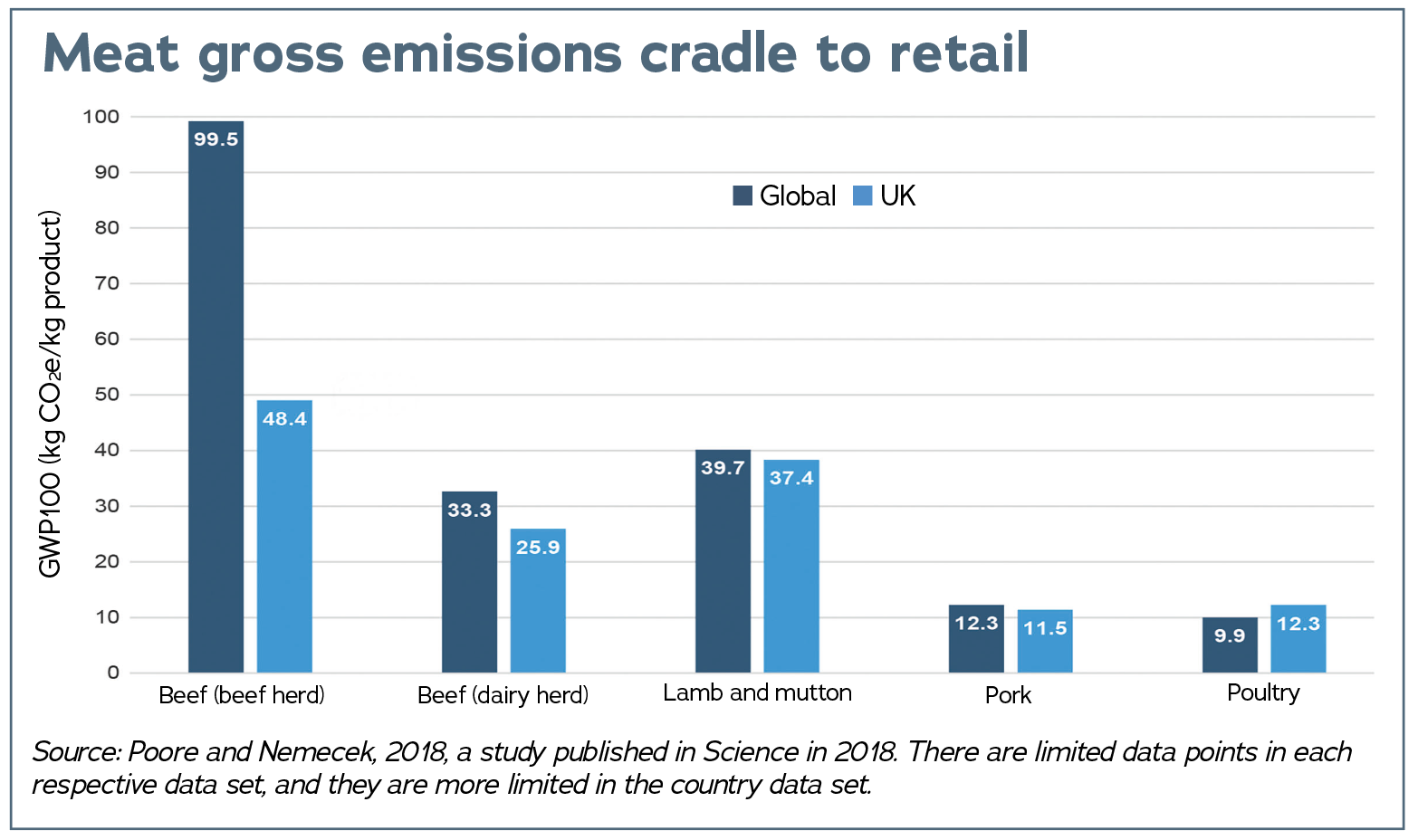
- Retail British pork’s global footprint, 11.5kg CO2e/kg deadweight, is similar to global pork at 12.3kg CO2e/kg – but way lower than UK beef (48.4kg CO2e/kg), dairy (25.93kg CO2e/kg) and sheep (37.43kg CO2e/kg) and marginally below poultry (12.33kg CO2e/kg).
- At farmgate level, British pork has a significantly lower footprint than the global average (4.96 vs 9kg CO2e/kg), which, again, is a fraction of that of its major red meat competitors.
The roadmap also explores a different measure for global emissions, considering emissions in relation to the amount and quality of protein a food provides, rather than weight alone.
By this measure, global average emissions for pork are estimated at 7.6kg CO2e per 100g of protein (see graph below), compared with 49.9kg CO2e/100g for beef, 19.9kg CO2e/100g for lamb and mutton, 16.9kg CO2e/100g for dairy and 5.7kg CO2e/100g for poultry.
Meanwhile, a 2024 Defra Agri-climate report revealed pigs have delivered the largest proportional reduction in emissions intensity of any major UK livestock sector since 1990. Between 1990 and 2022, emissions intensity fell by 46%, driven by a 41% reduction in animal emissions and a 10% increase in pigmeat production.
Continued improvement
Mr Crabtree said: “This roadmap is a significant step forward for the British pork sector. From the outset, we were clear it had to be grounded in robust evidence, and that principle has guided every stage of its development.
“It provides a transparent picture of where we are today, highlights the substantial progress already made and sets out a credible path for continued improvement. It will continue to evolve as new data, innovation and insight emerge, helping to ensure the sector remains environmentally responsible and commercially resilient.”
Jenny Gibbons, AHDB’s senior environment manager, said: “What makes this so powerful is that organisations have come together and worked collaboratively for the good of the wider industry. This is a genuine opportunity to make a difference to pork’s environmental impact in a way that allows everyone to play a part.
Mrs Wilson said the roadmap will ensure the sector is ‘telling its own story with confidence, backed by data’.
“For too long, we’ve had to suffer others telling our story. This will give us a stronger mandate and evidence base to use in discussions with government, retailers and wider stakeholders, and help us defend the sector by being able to prove clearly where we have already made progress, and where future support or policy alignment may be needed.
“Most importantly, the roadmap is ambitious but practical. It reflects the reality that environmental progress must be aligned with commercial viability.”