




Britain’s productivity puzzle is turning into a crisis’, was a striking headline in the Financial Times last year.
The article examined the poor growth in the UK economy in recent years and tried to find answers. Well, they should have looked at what the British pig industry has achieved over the past three decades.
They would certainly have been impressed and hopefully inspired by what has happened, despite numerous challenges and crises along the way.
Individual farming families and companies have invested heavily in pig production, sometimes with the support of customers and sometimes without it.
The result has been a more concentrated, increasingly efficient industry producing high-quality food to ever higher standards, all done in the face of fierce competition from EU member states.
The sow herd
Back in the mid-1990s, things were looking pretty good for the pig industry. Demand for pigmeat benefited from publicity around BSE, and supplies were tight on the European market following an outbreak of classical swine fever in the Netherlands.
Early in the decade, parliament agreed to a unilateral ban on the use of sow stalls and gave the industry until the start of 1999 to make the necessary changes.
Retailers and others made encouraging noises about supporting higher welfare and British production standards – many producers, therefore, made the necessary investments to comply with the law.
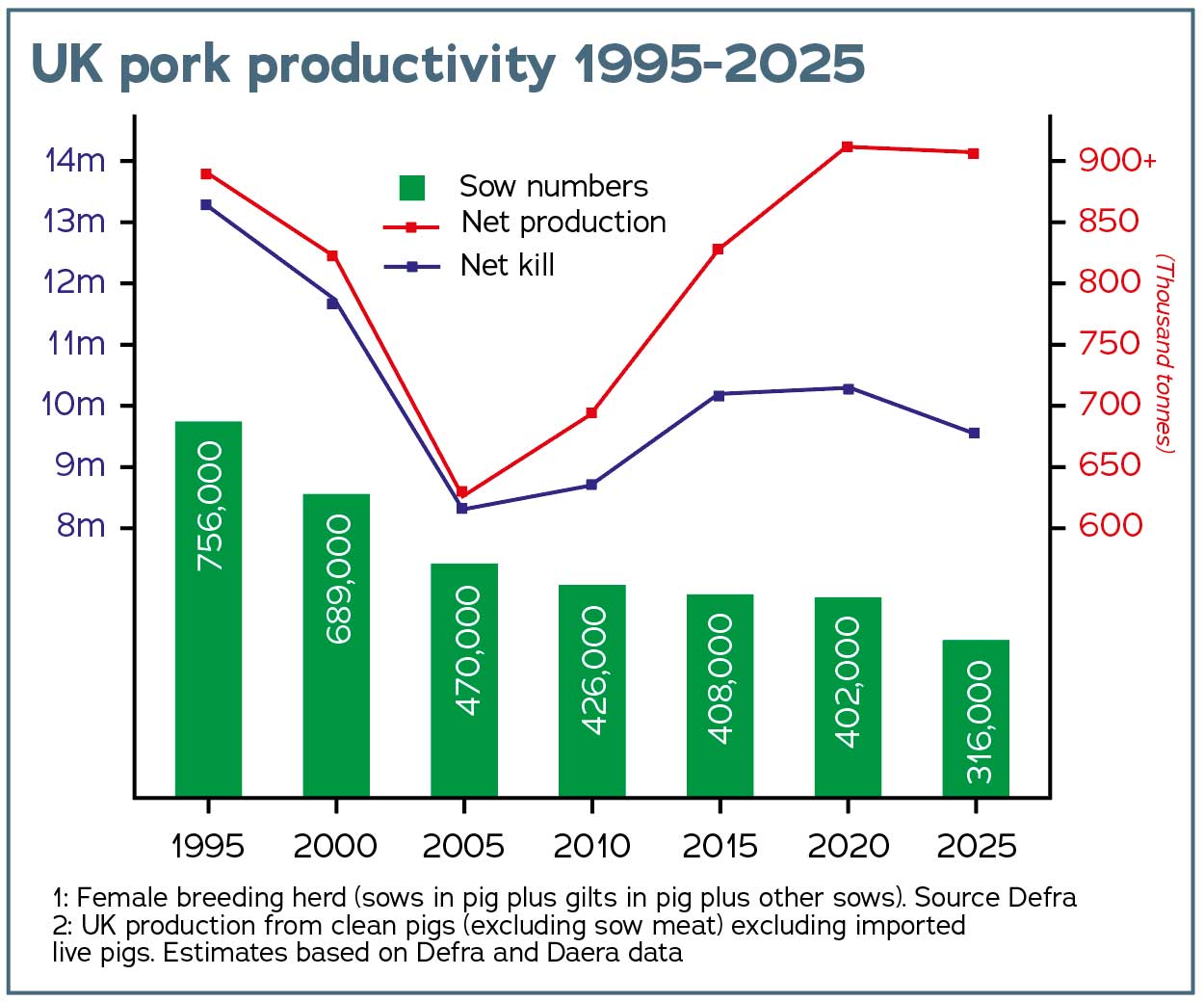
All of this resulted in an expansion in the breeding herd, with UK sow numbers reaching about 800,000 head.
Unfortunately, the financial crisis that started in Asia in late 1997 resulted in a collapse in global pork prices, which hit Europe in 1998. By the middle of the year UK prices were falling sharply, undermined by cheap imports.
The industry was then hit by a classical swine outbreak in East Anglia in 2000 and then foot-and-mouth in 2001. Many producers were forced out of business or decided the risks were too great.
However, other producers stuck with it, either as independents or as contractors for larger producers or corporate businesses. By 2005, the sow herd was down to 500,000 and by 2015 it had shrunk to about 400,000.
After some stability, it looks as if the sow numbers recorded in the annual census may be heading towards 300,000, although there are questions about the accuracy of this figure.
Pig slaughtering
This long-term trend may look like an indication of failure, but it is what those producers who have stayed in business are doing that is so impressive. Published data gives a broad indication of how the industry was performing.
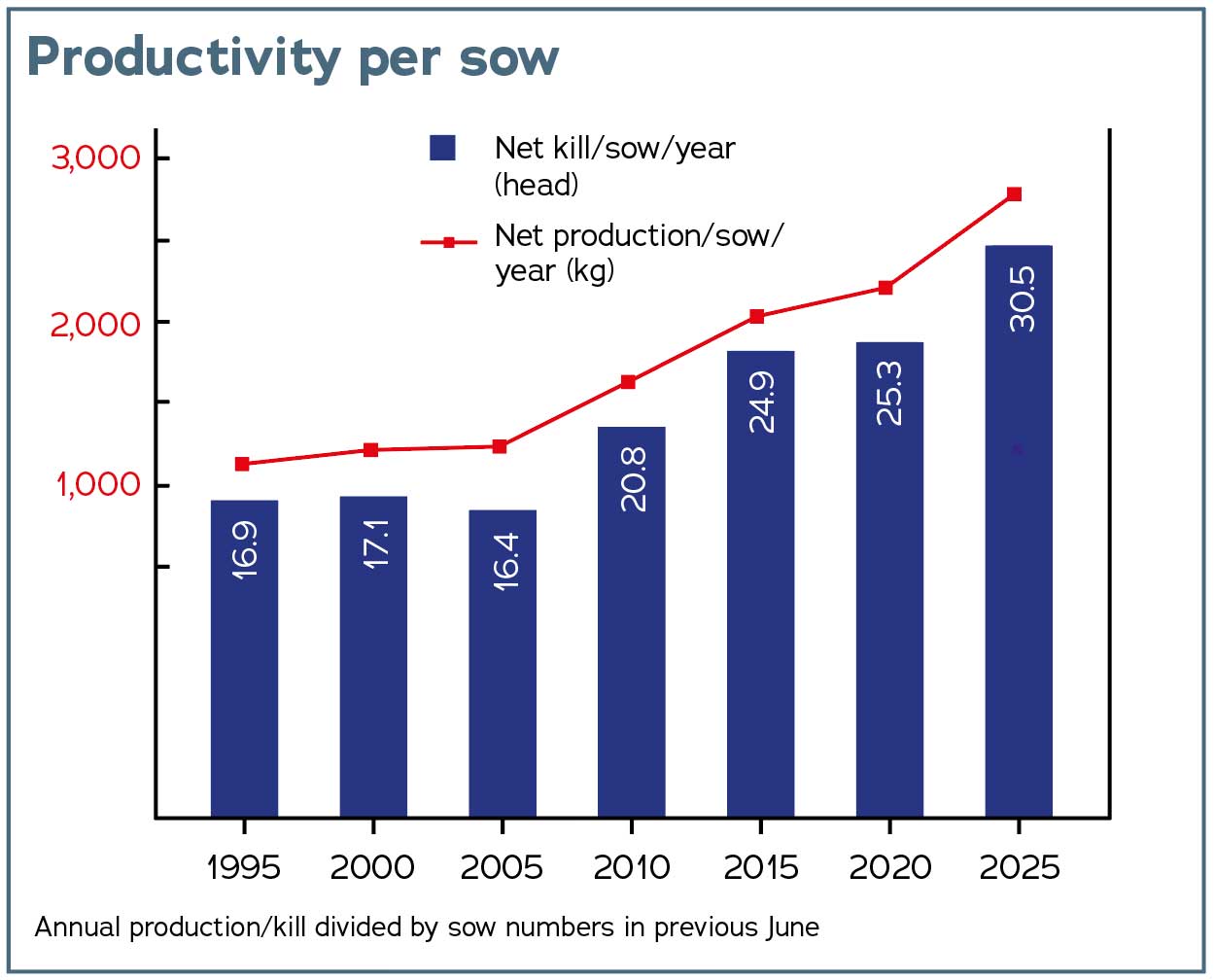
Back in 1995, the UK produced 13.5 million slaughter pigs. Comparing that with the number of sows the previous June, it equates to about 17 pigs finished per sow per year.
During the turmoil of the early 2000s, this fell to below 16 pigs/sow. However, once the herd stabilised, national production in 2010, it was more than 20 pigs/sow and by 2015, it was nearly 25 pigs/sow.
In recent years productivity on this measure has picked up again, with national data indicating just over 30 finished pigs/sow in 2025. This recent figure may look a little high compared with other industry data.
A weighted average of AgroVision performance data published by AHDB for 2025 indicates average performance of about 26 pigs finished/sow, with top-third performance close to 30 pigs/sow.
It is possible that the industry as a whole is operating closer to the top-third than the published average. However, it is also possible that the number of sows recorded in the June 2024 census at 327,000 is a little on the low side.
I suspect the reality is somewhere between the two. Whatever the exact figures are, we know that last year we produced 10 million slaughter pigs from a breeding herd that was half the size it was 30 years ago.
Carcase weights
Back in the mid-1990s, the average weight of a slaughter pig carcase was just under 67kg cold weight.
While weights had been edging up, the market was still constrained by contracts that penalised pigs that were taken to what was seen at the time as excessively high weights.
Lots of concerns were raised by processors about their ability to handle larger pigs and especially being able to butcher bigger pigs into visually acceptable chops, steaks and joints.
This was despite the fact that about half the pigmeat on sale in the UK came from the EU, where carcase weights were already considerably higher than in the UK.
Boar taint was also a major concern given that virtually all male pigs were left entire in the UK.
Breeding companies had already eliminated the halothane gene in previous years, with research subsequently focused on the effect of feed and the speed of growth on eating quality.
This, combined with more innovative butchery techniques and the pressure of lower slaughter numbers, resulted in the gradual lifting of weights in contracts.
By 2005, average weights were up to 75kg, and in 2015 they topped 80kg. By 2025, they averaged nearly 91kg.
Meat production per sow
The increased number of heavier pigs has resulted in a truly impressive increase in the capacity of sows to produce pigmeat.
In 1995, the UK produced about 1,100kg/sow/year. By 2005 it had edged up to 1,200kg, but by 2015 it had hit more than 2,000kg. Although this had taken a little longer than hoped for, the UK eventually joined the ‘two-tonne club’.
In the past 10 years there has been an acceleration and in 2025 we reached just short of 2,800kg/sow/year – well over double the 1995 figure.
In terms of national production, we produced 896,000t of pigmeat from a sow herd of 796,000 in 1994 – a relatively crude measure in any one year, but great to illustrate long-term trends.
The peak production year was 1998, with 1,055,000t from 800,000 sows in 1997.
But move forward three decades from 1995 and in 2025 we produced 906,000t from 327,000 sows in 2024 – that’s more pigmeat than 30 years ago from just 41% of the sow numbers.
Quality
Perhaps the most impressive thing of all when looking back over the past 30 years is that the productivity gain has been achieved without undermining quality, at least as far as fat levels are concerned.
In the mid 1990s, the average P2 measurement was 11.2mm on a carcase of 67kg. By 2010, the average was 10.5mm on a carcase of 78kg.
At the time, many in the industry were questioning whether this move to bigger and ever-leaner pigs was affecting eating quality.
As maximum weights in contracts increased, so did the grading profiles. As a result, by last year the average P2 was 11.7mm on a carcase of 91kg – an increase over 30 years of 0.5mm, while carcase weights have increased by 24kg.
In summary, the UK pig industry’s achievement in managing to produce roughly the same amount of quality pigmeat with less than half the number of breeding sows over the past 30 years is something to be celebrated.
For those trying to grapple with the puzzle of how to improve productivity in the UK economy, maybe they should take time to look at the skill, innovation, commitment and determination of British pig producers and the allied industry that supports them?