


With significant pressure on pig production margins, maintaining positive respiratory health is fundamental for achieving healthy and efficient production. However, the impact of respiratory disease (lung health) is not always obvious. Reduced average daily gain (ADG) and poorer feed efficiency can quietly increase production costs, even in the absence of obvious clinical signs.
Mycoplasma hyopneumoniae (M. hyo) and Porcine Circovirus Type 2 (PCV2) are two important contributors to these production losses, thereby making effective and measurable control essential.
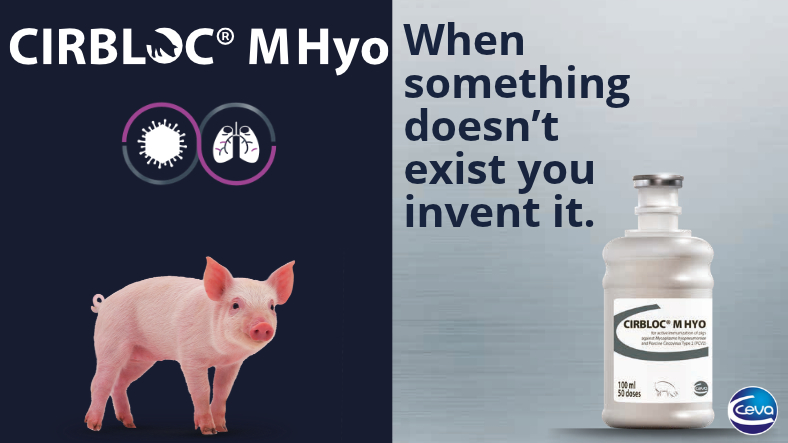
Introducing Cirbloc® M Hyo
- Cirbloc® M Hyo is a ready-to-use combination vaccine containing a PCV2d antigen and Ceva’s hyopneumoniae strain 2940, the same strain as used in Hyogen.
- Cirbloc® M Hyo provides 23 weeks’ duration of immunity for both PCV2 and hyo.
- PCV2d is currently the most predominant genotype circulating within the UK & IE. (APHA). Cirbloc M Hyo contains the PCV2d antigen.
- Cirbloc® M Hyo has also demonstrated cross-protection against the less prevalent PCV2a and PCV2b genotypes in challenge studies.
Commercial field evaluations demonstrate how improved disease control can translate into measurable production and economic benefits. Cirbloc® M Hyo was associated with up to 6.9 kg greater slaughter weight, contributing to an estimated economic benefit of up to €7.80 per pig (Czerniecki M. et al 2026).
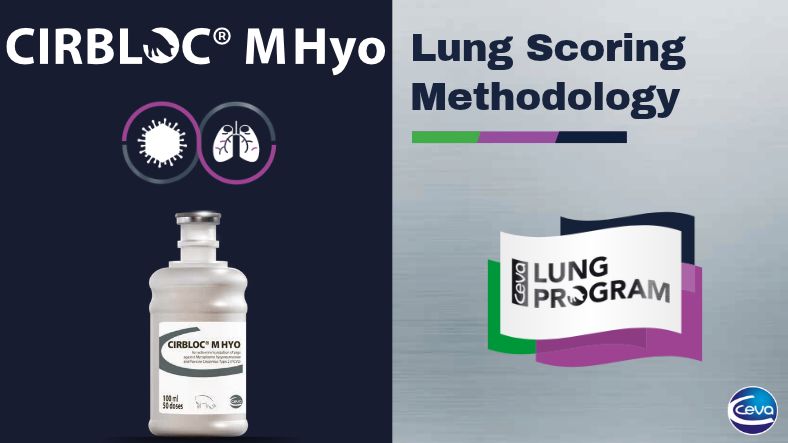
Ceva Lung Program (CLP): More than just lung scoring
The Ceva Lung Program (CLP) transforms the way respiratory disease is tracked and managed on farms. By systematically evaluating all lungs at the abattoir, the CLP identifies not just the visible disease, but the subclinical damage that silently cuts into efficient and healthy pig performance.
CLP provides a herd-wide overview on lung health. It enables benchmarking across farms & seasons, allows for variability assessments and provides valuable data on vaccines & vaccination protocols which are being used or evaluated on farm.
The strong relationship between respiratory health and performance can be measured at slaughter. Analysis of eight field trials using the Ceva Lung Program (CLP) found that a 0.365-point reduction in EP index was associated with a 39 g/day improvement in ADG, equivalent to approximately 11 g/day for every 0.1-point reduction in EP index (Krejci R a, Kalina J, Kuncova M. 2022)
This highlights how improvements in lung health can translate into productive performance.
Together, these findings highlight the economic importance of respiratory health and demonstrate how effective control of PCV2 and M. hyo with Cirbloc® M Hyo can support growth, feed efficiency and healthy performance throughout the production cycle.
Looking ahead, the journey has just begun
In a world of tightening margins and rising scrutiny over antimicrobial use, producers need more than just treatments, they need predictability and performance efficiency. This requires a vaccine that can meet the evolving challenge, tools that provide detailed measurements, and a mindset that goes beyond the point of vaccine administration.
Cirbloc® M Hyo and CLP are not just individual solutions, together, they form a synergistic approach for health management. This approach marks a shift towards precision in pig health management: Focusing on proactive control, supported by robust evidence, rather than reactive methods, unknown reasons and performance variability.
By embracing data-driven decision making and utilising available tools, pig producers can unlock the full potential of every pig, driving both health and production efficiency.
For more information on Cirbloc® M Hyo, please contact your vet.
References
- Czerniecki M. et al. Comparison of three combined vaccines against PCV2 + Mycoplasma hyopneumoniae on performance parameters in pigs under field conditions. IPVS 2026
- Krejci, R., Kalina, J. and Kuncová, M. 2022. A meta-analysis of the relationship between lung lesion scores in slaughter pigs and their daily weight gain. International Animal Health Journal. 9 (2), pp. 24-28.