




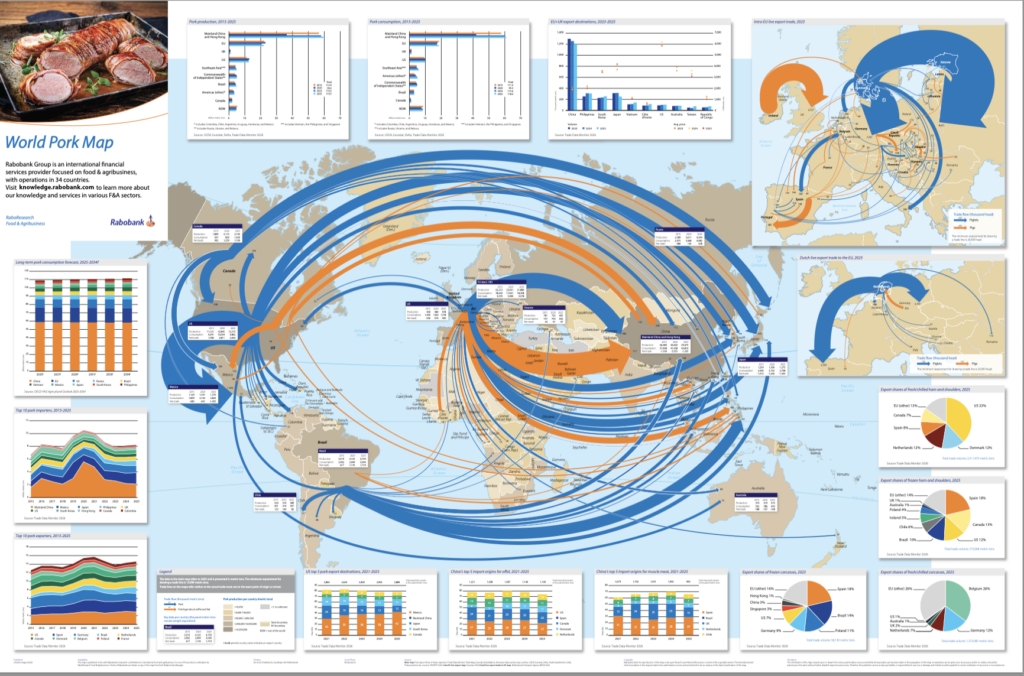
China’s influence on international pork trade flows is declining while competition among exporters intensifies, as global pork trade is entering a new phase, a new report and the World Pork Map from RaboResearch shows.
As China’s share of global imports falls, trade is becoming more diversified, with markets such as Mexico and Southeast Asia playing a growing role, while animal health developments, trade policies, and geopolitics are increasingly shaping trade outcomes alongside traditional cost competitiveness.
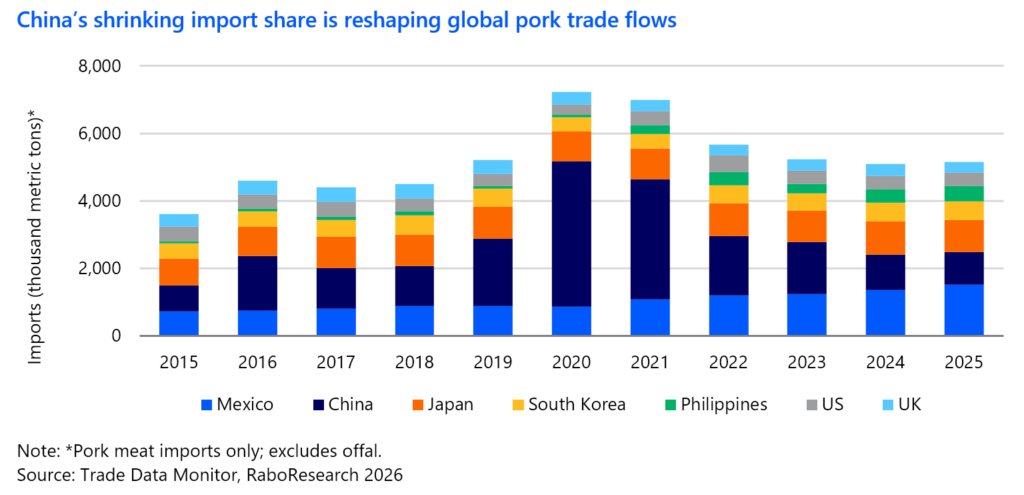
Global pork trade was transformed by China’s African swine fever (ASF) crisis between 2018 and 2021, which drove a surge in Chinese import demand for pork.
But following the recovery of China’s domestic production, global trade volumes have stabilised at lower levels, creating a more balanced but less dynamic market environment, the report highlights. China remains the world’s largest pork importer, but its share of imports has declined sharply, influencing international trade flows.
“Global pork trade has clearly moved away from the China-centric model that defined the previous decade,” says Éva Gocsik, global head of animal protein at RaboResearch. “A broader range of importing countries now determines market opportunities.”
You can download the Global Pork Map HERE.
Key growth markets
As China’s influence has diminished, exporters have increasingly turned to alternative destinations. Mexico is now the world’s largest importer of pork meat, excluding offal, while countries such as the Philippines and Vietnam continue to rely on imports due to ongoing animal health challenges and domestic supply constraints.
“Growth is no longer concentrated in a single market,” said Ms Gocsik. “That creates opportunities but also increases competition among exporters seeking to strengthen their positions across destinations.”
The EU remains the world’s largest pork exporter, but the US has narrowed the gap as tightening environmental regulations, animal welfare requirements, and rising costs constrain EU growth, and is poised to become the leading exporter in the future.
Brazil has also strengthened its position by diversifying exports beyond China, with countries such as the Philippines becoming increasingly important destinations.
“As trade flows become more dispersed, exporters are increasingly competing head-to-head across a wider range of markets, placing greater emphasis on cost efficiency, product differentiation, logistics capabilities, and market access,” Ms Gocsik.added
Trade influences
The report also highlighted how exporter profitability and competitiveness are no longer driven solely by production economics, as animal disease outbreaks, evolving regionalisation agreements and sanitary restrictions, tariffs, and geopolitical tensions are increasingly shape market access and trade flows.
“Successful exporters will need to be agile, diversify risk across markets, and develop strong capabilities in biosecurity, compliance, and market access management,” Ms Gocsik concluded.
“Global pork trade is no longer driven by a single destination market. Success will increasingly depend on managing a diversified portfolio of products and markets.”