



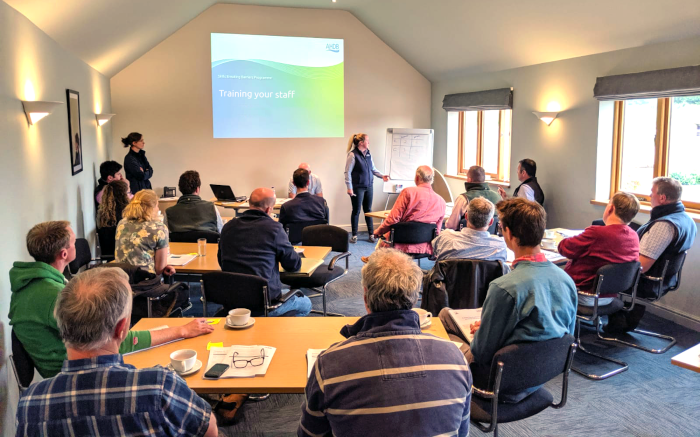
An AHDB review of training provision across the English pig sector has set out proposals for coordinated action to strengthen recruitment, retention, skills development and career progression across the industry.
Undertaken by Dr Sam Hoste, Dr Lindsay Heasman and Helen Cuppello, the review was conducted between January and April 2026, with input from 43 face-to-face interviews and an anonymous online survey.
It found that the pig sector faces significant workforce challenges, driven by a tightening labour market, changing expectations from new entrants and increasing competition from other industries offering clearer career pathways.
It highlighted the lack of accessible, coherent signposting of pig sector training and the need to move beyond viewing training as a series of isolated courses towards a broader professional development approach that supports recruitment, accreditation, continuous learning and career progression.
Respondents strongly preferred face-to-face and group training over online delivery ––online is acknowledged as necessary for mandatory reach but is not seen as sufficient.
It identified a ‘significant gap’ in people management and leadership training, concluding that, as farms grow and move from family to employee labour, technical pig skills alone are insufficient
It found that training is not currently embedded in a wider human resource management (HRM) framework but ‘stands alone, disconnected from recruitment, retention and career development’.
“The sector needs a clear career pathway – without one, it is losing people to other agricultural sectors that offer better structured professional development,” the review concluded.
AHDB is seen as the natural convener and champion for a more coherent training landscape, but not necessarily as the primary delivery organisation
Key recommendations
The report sets out 16 recommendations designed to help future-proof the sector’s workforce, including the creation of a dedicated working group to drive implementation of the remaining recommendations and maintain momentum for change.
It will bring together independent pig farms, integrators, training providers, retailers, hauliers, education providers, Red Tractor and Defra.
Other recommendations include:
- Create an online pig training and career hub (signposting and CPD records)
- Develop routine engagement with HRM teams across pig businesses
- Modularise training to increase relevance across production systems
- Develop best practice guidance for induction
- Update certificates of competence and core training materials
- Introduce mandatory refreshers for moving and handling and WATOK
- Develop accreditation, CPD framework and trainer qualification
- Clarify and formalise AHDB/TIAH roles and collaboration
- Initiate a biannual Pork Professionals Development Conference
- Champion apprenticeships and new entry pathways
- Secure training and professional development as a protected budget item ahead of 2027 Shape the Future vote
- Explore co-production with animal health, nutrition and genetics companies
- Engage Defra to fund innovative tools (GoPro, ProHand, Gemba).
AHDB said the review recognises that while there is strong appetite for change, there is currently no sector-wide mechanism to coordinate activity. The working group will help ensure that recommendations are prioritised, refined where necessary and translated into meaningful action rather than remaining as standalone recommendations.
The ambition is for the working group to develop a fully costed implementation plan by the end of March 2027, including delivery timelines, resource requirements and potential delivery partners.
- You can download the summary report here
- The full 49-page report is available on request; please email pork.kt@ahdb.org.uk
Stockperson training programme
AHDB’s existing stockperson training programme will continue unchanged during the current financial year, with around 30 training sessions scheduled between October 2026 and May 2027.
These courses will remain a core part of AHDB’s training offer while longer-term plans are developed.