


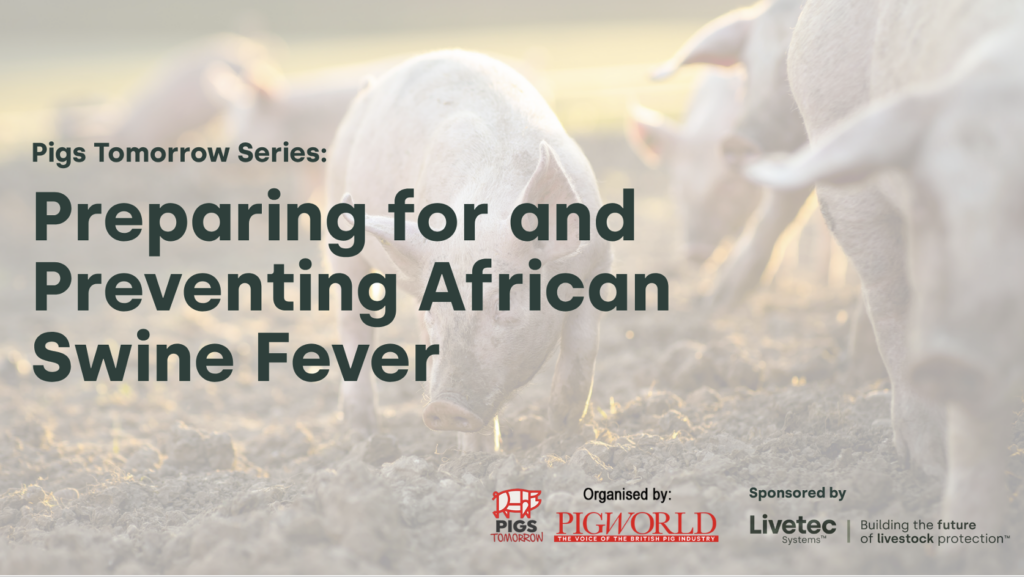
Act now before it’s too late, was the key messages from the first Pigs Tomorrow webinar that took an in-depth look at ‘Preparing for and Preventing for African swine fever (ASF)’.
Sponsored by Livetec, the hour-long webinar – which is still available to watch – began by setting out the current ASF disease picture, with 15 countries in Europe reporting cases over the past two months, alone.
NPA chief policy adviser Katie Jarvis highlighted how ongoing outbreaks in Germany, since 2020, Italy, since 2022, and, more recently, in Spain, show just how easy it is for the virus to get into country – but how difficult it is to get rid of.
The consequences of an outbreak for major pig producing countries is huge – at one point, Italy was losing €20m a month in lost exports, let alone the direct impact on affected farms and indirect impact of ASF restrictions.
Ms Jarvis also discussed the targeted criminal trade in illegal meat products coming through the Port of Dover, in particular, and the NPA’s frustration, shared across the industry, at the lack of resource available for the hard-working port health team to tackle the problem at the frontline. Despite only being able to provide 20% coverage at the port, DPHA has now intercepted more tha. 400t of illegal meat, with volumes increasing markedly in recent months.
She said the NPA continues to push for a fairer settlement for DPHA, proportionate to the cost of an outbreak their work could prevent.
AHDB senior animal health and welfare scientist Miranda Poulson outlined the preparatory work that has been going on behind the scenes between the industry and government, praising the level of engagement from Defra and some of its agencies. This work has focused on a range of areas, including communications in the event of an outbreak and the nature of the controls that would be in place.
She also highlighted the success of a series of workshops run by AHDB, NPA and Livetec, in association with veterinary practices, offering practical advice on ASF, including the development of bespoke continency plans.
All the key findings from those meetings and lots of useful resources have been brought together, on request, in a ‘Workshop in a Box’ from AHDB.
Biosecurity is key
While a lot has been done to up ASF defences on farms and across the supply chain, there is always more to do, according to Livetec’s Paul Talling.
When it comes to ASF prevention, the UK has the advantage of being an island – but one of its disadvantages is the number of pigs kept outdoors. While experience in Europe has consistently shown that the implementation of strict biosecurity measures can stave off infection on indoor units, the challenges are much greater when pigs are kept outdoors.
Along with the rest of the panel, he stressed the critical importance of maintaining high biosecurity standards at all times, across all parts of the supply chain.
Livetec’s direct experience across both sectors suggests poultry has moved ahead of pigs in its biosecurity standards, driven by having to cope with avian flu in recent years. But his message to the pig sector was that there is no point upping industry standards once disease is here – it needs to be done now to prevent it reaching pigs in the first place.
He delivered a range of specific advice on biosecurity, including around visitors and vehicles entering the premises, but also stressed the importance of preparing now in case there is an outbreak.
Again, it is much better to act now when it comes to contingency planning – including record keeping and planning for various eventualities such as cleansing and disinfection of the unit and movement restrictions – than having to do so under immense pressure ‘in the heat of battle’ after the virus strikes.
The message from all participants was that ASF is the single biggest threat facing the pig sector – but an outbreak is not inevitable and there is a huge amount that can be done now to prevent it and, if necessary, to prepare for it.
- The webinar is still available to view HERE.