


The British pork sector’s long-awaited Pork Environmental Roadmap has highlighted the impressive progress made by the industry in reducing its carbon footprint over the past two decades, confirming the sector’s sustainable credentials.
Developed by an industry-led steering group and facilitated by AHDB, the roadmap sets out an evidence-based framework to guide future environmental gains, continued improvement and a stronger platform for demonstrating the sector’s environmental performance.
A significant piece of work, published today, it is structured around seven strategic priorities: net carbon; air quality; water stewardship; slurry, manure and nutrient management; biodiversity; waste and recycling; and on-farm energy.
The evidence shows that British pork production has already made significant gains. A new life cycle assessment highlights an 18% reduction in carbon footprint between 2008 and 2023.
Over the same period, emissions linked to land use and land-use change fell by 71%, reflecting major improvements in feed sourcing and pig diet formulation. These improvements have been driven by long-term advances in efficiency, particularly feed efficiency, productivity and innovation across the supply chain.
Fossil resource use has declined by 12% since 2008, reflecting improvements in energy efficiency across feed production, processing and on-farm operations, as well as a reduced reliance on fossil energy per unit of pork produced.
The pig sector accounts for only 4% of the total UK agriculture emissions, according to the roadmap document and pigs have delivered the largest proportional reduction in emissions intensity (GHG emissions from producing a kg of pork) of any major livestock sector since 1990.
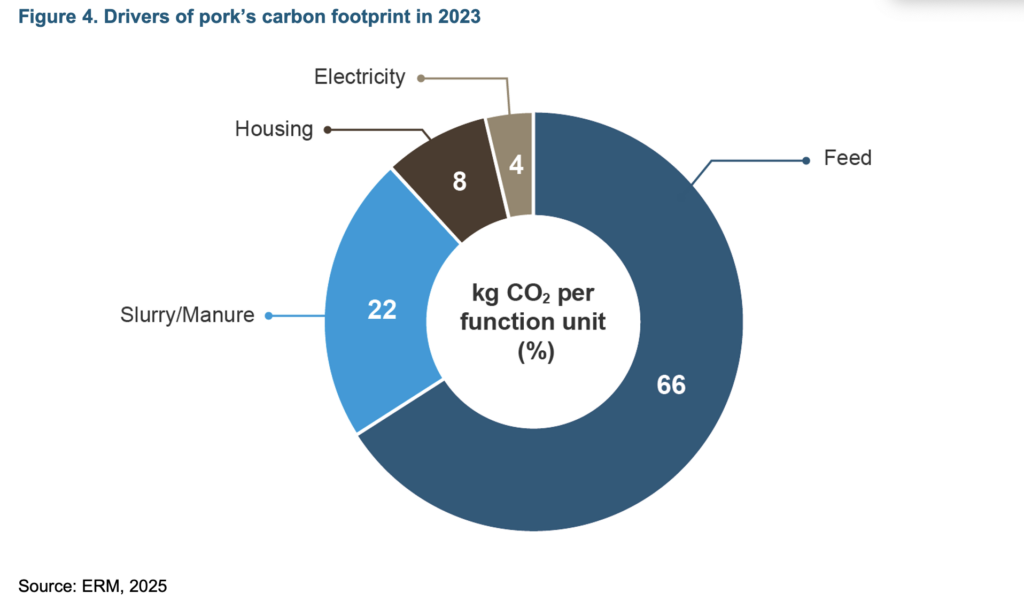
Between 1990 and 2022, emissions intensity fell by 46%, driven by a 41% reduction in animal emissions and 10% increase in pig meat production. At farm level, four main drivers influence emissions: feed (66%), slurry/manure (22%), housing (8%) and electricity (4%).
At a global level, it shows:
- Retail British and global pork footprints are broadly similar (11.5 vs 12.3 kg CO2e/kg deadweight)
- At farmgate, British pork has a significantly lower footprint than the global average (4.96 vs 9.0 kg CO2e/kg).
Further evidence shows that between 1990 and 2021, the British pig industry reduced its global warming potential (GWP) by 37% in the indoor sector and 35% outdoors, largely due to higher growth rates and improved carcase, which reduced overall energy requirements.
The roadmap also compares UK and global emissions with other sectors, showing pork comparing favourably to beef, lamb and dairy, and slightly above poultry.
When calculated on the basis of per kilogram of product, global average emissions for pork are estimated at 7.6 kg CO2e per 100g of protein, compared with 49.9kg CO2/100g for beef, 19.9kg CO2/100g for lamb and mutton, 16.9kg CO2/100g for dairy and 5.7kg CO2/100g for poultry.
Action plan
Across each area, the roadmap highlights the importance of robust data, consistent measurement and collaboration across the supply chain in deliver meaningful and measurable change, according to the organisations and individuals behind it.
Bringing together the latest data, practical experience and sector insight, it is designed to help the pig sector demonstrate progress, respond to growing scrutiny and strengthen the long-term resilience and competitiveness of British pork production.
The roadmap also sets out an action plan for 2026 to 2030, focused on strengthening the evidence base, scaling best practice and supporting the adoption of new technologies. Progress will be monitored through regular five-yearly life cycle assessments, helping to ensure transparency and accountability over time.
Hugh Crabtree MBE, chair of the Pork Environmental Roadmap Steering Group, said: “This roadmap is a significant step forward for the British pork sector. From the outset, we were clear it had to be grounded in robust evidence, and that principle has guided every stage of its development.
“It provides a transparent picture of where we are today, highlights the substantial progress already made and sets out a credible path for continued improvement. It will continue to evolve as new data, innovation and insight emerge, helping to ensure the sector remains both environmentally responsible and commercially resilient.”
”If there are challenges to our findings, let’s be hearing about them! We believe our progress to a more sustainable future will come from robust dialogue.”
NPA chief executive Lizzie Wilson said: “For producers, it’s about practical, achievable improvement. It supports better decision making, helps businesses prepare for future policy and market expectations, and reinforces the reputation of British pork as a sustainable, high-quality product. Most importantly, it ensures the sector is telling its own story with confidence, backed by data.”
The roadmap is intended to be a dynamic framework that will evolve over time, incorporating new evidence, case studies and innovation to support continuous improvement across the sector.
The organisations and individuals that have supported the roadmap:
AIMS
British Meat Processors Association
Cameron Naughton
Cranswick plc
David Black & Sons
Hugh Crabtree
National Pig Association
Nick Major (independent)
Pilgrims Europe
Quality Meat Scotland
Red Tractor
Sofina
Tom Allen