



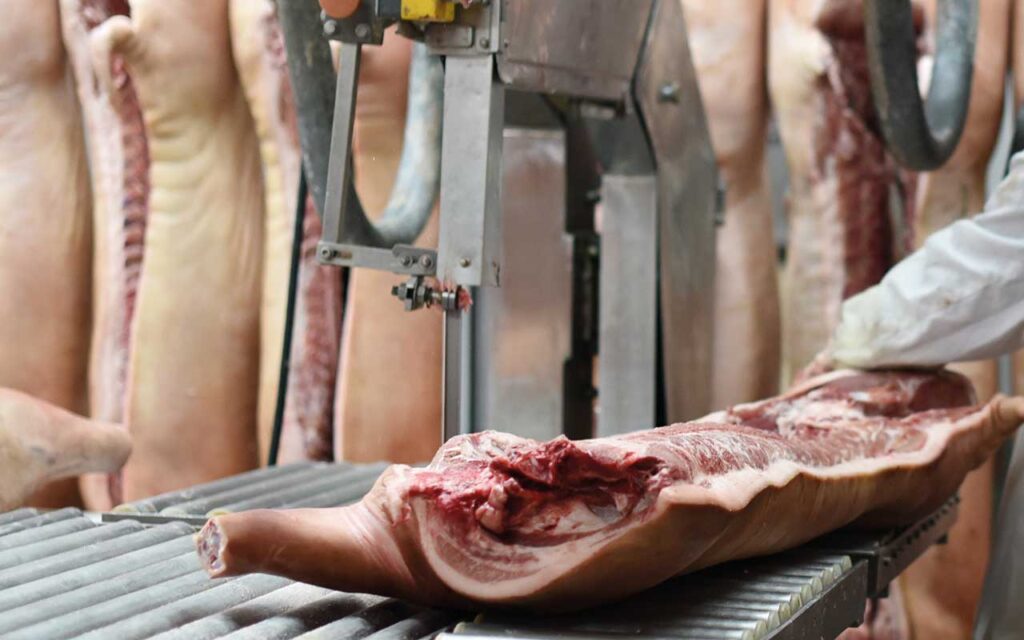
In the early 1970s, there were well over 1,000 red meat abattoirs operating across the UK. By the mid 1990s, that number had fallen to about 400.
Recent figures indicate that fewer than 200 red meat abattoirs remain operational, with only a fraction classified as genuinely small, multi-species local facilities.
In England and Wales alone, dozens of small plants have closed in the past 15 years.
“The contraction of small abattoirs in the UK has been significant and measurable,” said Amir Mohammad, who has been awarded a 2026 Nuffield farming scholarship to investigate the decline of small abattoirs in the UK.
“Some counties that historically had multiple facilities now have none. In parts of south-west England, Wales and Northern England, livestock often travel 60-100 miles for slaughter. In some remote regions, the journey can exceed two hours.
“The pig sector illustrates this concentration clearly. The majority of UK pigs are now processed by a small number of large processors.
“While these businesses are highly efficient and globally competitive, consolidation has reduced local flexibility for small and specialist producers. The loss of small- and medium-scale slaughter capacity has narrowed marketing options, particularly for rare-breed, organic, outdoor-reared and direct-to-consumer enterprises.”
Farmers survey
A survey of 850 farmers and land managers across the UK last year, carried out by the Sustainable Food Trust, Soil Association and Rare Breeds Survival Trust, highlighted the wider importance of the small and local abattoir service.
58% of respondents said their business would not be profitable without selling direct to consumers or through local markets – a model that depends heavily on private kill and further processing services offered by small and local abattoirs.
Many respondents expressed concerns about the animal welfare implications of long-distance transport, typically beyond 30-40 miles, to abattoirs, which they felt undermines their high on-farm welfare standards, with 10% of respondents saying they travel more than 60 miles to reach their closest abattoir.
One-third of respondents said their local abattoir had closed in the past five years, while one-quarter reported that their abattoir is too busy or fully booked, often due to nearby closures.
Megan Perry, head of policy and campaigns at the Sustainable Food Trust, described small local abattoirs as the ‘lynchpins of local meat supply chains’ and warned that ongoing closures could ultimately see the widespread loss of local meat. “This undermines the UK’s resilience, food security, native breeds and nature-friendly farming,” she said.
The organisations behind the survey urged the government to recognise the importance of the abattoir network and define it as critical national infrastructure, ensuring its inclusion in national and local food, farming and land-use strategies.
Nuffield research

Mr Mohammad is currently working as continuous improvement manager for Corvedale Fresh, part of the Euro Quality Lambs Group. During his career, he has worked closely with abattoirs, cutting plants, livestock producers and certification bodies across the UK and internationally.
He explained that he chose his Nuffield topic – Killing sustainability, straining welfare: Ecological and ethical costs of UK small abattoir decline – ‘because small abattoirs are not simply processing facilities’.
“They are critical infrastructure within rural economies. Their decline is reshaping livestock production systems, altering welfare outcomes and concentrating market power in ways that are rarely discussed in a holistic manner,” he said.
“As someone who has worked inside both small independent plants and large high-throughput facilities, I have seen at first hand how policy, cost pressures and regulatory structures have progressively marginalised smaller operators.”
Your views on abattoirs
Harper Adams University student Audrey Venners is also researching the decline of small abattoirs for her final year dissertation, focusing on pigs.
She has launched a survey to explore how the decline may be affecting pig welfare in the UK. It takes about 5–10 minutes to complete, and all responses are completely anonymous.
Small abattoir benefits
He explained some of the benefits he believes small abattoirs provide:
Animal welfare: Longer journey times increase stress, particularly in species that are sensitive to transport. Research consistently shows that transport duration, mixing of unfamiliar animals and lairage conditions affect cortisol levels, skin damage and meat quality outcomes such as PSE and DFD, with effects varying between species.
When local abattoirs close, producers have fewer options to match slaughter timing with optimal welfare conditions. Emergency slaughter or casualty management also becomes more complex without nearby facilities.
In some cases, animals that could have been humanely processed locally must instead be euthanised on farm without entering the food chain.
Small abattoirs often allow farmers to be present at slaughter, providing transparency and accountability. This direct oversight is valued by high-welfare producers and underpins many farm assurance and direct marketing claims.
Environmental impact: If an additional 50 miles per journey becomes standard across thousands of livestock movements annually, the cumulative carbon footprint increases significantly.
Small abattoirs also tend to support shorter supply chains. When livestock are reared, slaughtered, cut and sold within a defined region, cold-chain distances and packaging requirements are often reduced. Local processing can contribute to circular rural economies, whereby products are used regionally rather than transported over long distances.
Economic sustainability: From a broader livestock perspective, market concentration increases vulnerability. When small producers rely on a limited number of processors, price negotiation power shifts further up the chain. In periods of backlog, as seen a few years ago, smaller producers can be disproportionately affected.
Local abattoirs provide flexibility. They enable direct sales, farm shops, box schemes and niche butchery relationships. These higher-margin routes are often essential for small enterprises to remain viable.
The loss of small facilities does not simply reduce slaughter points. It reshapes the entire business model available to independent producers.
Gathering evidence
“This is not nostalgia for the past. It is about infrastructure resilience,” Mr Mohammad said. “Covid 19 exposed the fragility of concentrated processing systems worldwide. In several countries, temporary plant closures caused severe supply chain disruption.”
Regions with more decentralised capacity demonstrated greater resilience.
“If current trends continue, further closures may reach a tipping point where rebuilding local capacity becomes economically or logistically impossible. Skills, inspection knowledge and experienced slaughter personnel are not easily reassembled once dispersed.
“From a meat industry perspective, diversity of processing capacity is a risk management strategy. It is a buffer against shocks, labour shortages, disease outbreaks and market volatility,” Mr Mohammad said.
“Small abattoirs are often described as uneconomic. Yet we rarely account for the externalised costs of their disappearance: increased transport, reduced welfare flexibility, weakened local economies and concentrated market power. My Nuffield scholarship seeks to move the debate beyond sentiment and into evidence.”
The objective is to develop practical recommendations that support animal welfare, environmental responsibility and economic sustainability across the livestock sector.
The Nuffield scholarship
The scholarship is structured around three core components:
- UK-wide stakeholder engagement
Amir Mohammad will be conducting structured interviews with red and white meat producers, mixed farmers, small abattoir operators, processors, retailers, regulators and policymakers. Particular attention will be given to independent producers who rely on local slaughter facilities for niche and high-welfare markets. - International comparison
He will travel to countries that have faced similar structural challenges, but adopted different policy responses, including Australia, the US, Ireland, Germany, France, Italy and the Netherlands. These case studies will allow comparison of regulatory proportionality, inspection models, labour solutions and producer-led ownership structures. - Data analysis and final report
The final report will synthesise welfare data, economic modelling, environmental considerations and international best practice.
“The aim is not simply to document decline, but to propose realistic and implementable solutions for the UK context, including cooperative models, mobile slaughter units, fixed small abattoirs, regulatory recalibration and strategic policy interventions,” Mr Mohammad said.
Industry support
He would welcome the following support from the sector:
- Participation in confidential interviews and structured surveys
- Access to production, throughput and transport data where available
- Engagement from independent producers who rely on smaller plants
- Dialogue with large processors to understand their perspective on capacity, regulation and collaboration
- Policy engagement from industry.
He plans to publish polls and short discussion pieces to stimulate debate and will be attending industry events, visiting farms and abattoirs, and hosting roundtable discussions, where feasible.