


Pig World
  • News
      • Animal Health
      • Breeding
      • Business
      • Environment
      • EU
      • Food Safety
      • Housing
      • Marketing
      • NPA
      • National Pig Awards
      • New Products
      • Nutrition
      • People
      • Pig Fair
      • Politics
      • Training & Education
      • Welfare
  • Features
    • Animal Health
    • Breeding
    • Environment
    • Farm Visits
    • Herd Recording
    • Housing
    • Marketing
    • Nutrition
    • Products
    • Training
  • Comment
    • AHDB Pork
    • Chris Fogden
    • Dennis Bridgeford
    • Peter Crichton
    • Red Robin
    • Veterinary View
    • Zoe Davies, NPA
  • Numbers
  • Pig Prices
  • Magazines
    • October 2026
    • September 2026
    • August 2026
    • 2026 Pig Health supplement
    • July 2026
    • June 2026
    • 2026 Innovation supplement
    • 2026 British Pig & Poultry Fair guide
    • May 2026
    • April 2026
    • March 2026
    • 2026 Buildings supplement
    • February 2026
    • 2026 Pig Nutrition supplement
    • January 2026
    • December 2025
    • November 2025
    • 2025 National Pig Awards supplement
    • October 2025
    • September 2025
    • August 2025
    • 2025 Maximising Pig Health supplement
    • July 2025
    • June 2025
    • 2025 Innovation supplement
    • May 2025
    • April 2025
    • March 2025
    • 2025 Buildings supplement
    • February 2025
    • 2025 Nutrition Supplement
    • January 2025
    • December 2024
    • November 2024
    • 2024 National Pig Awards supplement
    • October 2024
    • September 2024
    • August 2024
    • 2024 Pig Health supplement
    • July 2024
    • June 2024
    • 2024 Innovation supplement
    • 2024 Pig & Poultry Fair Guide
    • May 2024
    • April 2024
    • 2024 Buildings Supplement
    • March 2024
    • 2024 Pig Nutrition supplement
    • February 2024
    • January 2024
    • December 2023
    • November 2023
    • 2023 National Pig Awards supplement
    • October 2023
    • September 2023
    • Health Supplement
  • Suppliers
  • Jobs
    • Browse Jobs
    • Post a Job
    • Manage Jobs
  • Classified
  • Events
    • Pigs Tomorrow
    • National Pig Awards
Subscribe
Pig WorldPig World
  • News
      • Animal Health
      • Breeding
      • Business
      • Environment
      • EU
      • Food Safety
      • Housing
      • Marketing
      • NPA
      • National Pig Awards
      • New Products
      • Nutrition
      • People
      • Pig Fair
      • Politics
      • Training & Education
      • Welfare
  • Features
    • Animal Health
    • Breeding
    • Environment
    • Farm Visits
    • Herd Recording
    • Housing
    • Marketing
    • Nutrition
    • Products
    • Training
  • Comment
    • AHDB Pork
    • Chris Fogden
    • Dennis Bridgeford
    • Peter Crichton
    • Red Robin
    • Veterinary View
    • Zoe Davies, NPA
  • Numbers
  • Pig Prices
  • Magazines
    1. October 2026
    2. September 2026
    3. August 2026
    4. 2026 Pig Health supplement
    5. July 2026
    6. June 2026
    7. 2026 Innovation supplement
    8. 2026 British Pig & Poultry Fair guide
    9. May 2026
    10. April 2026
    11. March 2026
    12. 2026 Buildings supplement
    13. February 2026
    14. 2026 Pig Nutrition supplement
    15. January 2026
    16. December 2025
    17. November 2025
    18. 2025 National Pig Awards supplement
    19. October 2025
    20. September 2025
    21. August 2025
    22. 2025 Maximising Pig Health supplement
    23. July 2025
    24. June 2025
    25. 2025 Innovation supplement
    26. May 2025
    27. April 2025
    28. March 2025
    29. 2025 Buildings supplement
    30. February 2025
    31. 2025 Nutrition Supplement
    32. January 2025
    33. December 2024
    34. November 2024
    35. 2024 National Pig Awards supplement
    36. October 2024
    37. September 2024
    38. August 2024
    39. 2024 Pig Health supplement
    40. July 2024
    41. June 2024
    42. 2024 Innovation supplement
    43. 2024 Pig & Poultry Fair Guide
    44. May 2024
    45. April 2024
    46. 2024 Buildings Supplement
    47. March 2024
    48. 2024 Pig Nutrition supplement
    49. February 2024
    50. January 2024
    51. December 2023
    52. November 2023
    53. 2023 National Pig Awards supplement
    54. October 2023
    55. September 2023
    56. Health Supplement
    Featured

    October 2026 issue of Pig World now available

    October 5, 2026
    Recent

    October 2026 issue of Pig World now available

    October 5, 2026

    September 2026 issue of Pig World now available

    September 4, 2026

    2026 Pig Health supplement now available

    August 1, 2026
  • Suppliers
  • Jobs
    • Browse Jobs
    • Post a Job
    • Manage Jobs
  • Classified
  • Events
    • Pigs Tomorrow
    • National Pig Awards
LinkedIn X (Twitter)
Pig World
Herd Recording

Applying manufacturing concepts to pig production

Guest WritersBy Guest WritersJanuary 4, 20166 Mins Read
LinkedIn Twitter Facebook Email

Eight years ago I began to explore the application of process control in pig production, writes Stephen Hall of Stephen Hall Management. This followed a conversation with an uncle who’d spent his working life in engineering; he’d travelled the world involved in the management of quality control, and had studied and implemented the Japanese manufacturing concept of ‘total quality’. He knew nothing about pig production, but as we talked it became clear that it was worth exploring how the efficiency of the pig sector might be measured in similar ways to the processes involved in manufacturing.

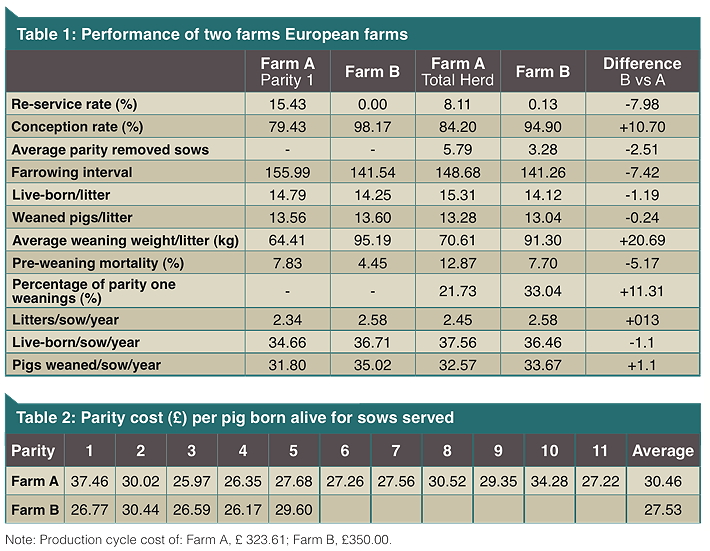
Table 1 shows the performance of two farms, Farm A and Farm B, both of which are commercial units in Europe – one from the UK. The first row of data indicates that Farm B is not serving gilts and sows that return. This is a strategy known as value engineering.

Producers reading may struggle to understand the value of this. The first two columns of data compare gilt (parity one) performance. Farm A is re-serving a high percentage of returns. The conception rate is comprised of the animals successfully served and the re-service rate indicates that several animals are being re-served multiple times, this means ‘old’ gilts eventually entering the breeding herd. This is keeping the eventual farrowing rate up where it is, yet it remains well below that of Farm B.

This highlights the need for a ‘total quality’ approach to gilt management. This approach is clearly being implemented at Farm B, as it’s culling all returns and achieving a farrowing rate of 98.17%. This high farrowing rate, in the absence of any re-service of returns, demonstrates what it’s possible to aspire to in terms of conception.

Producers purchasing parent gilts and their suppliers will understandably baulk at this. I have long argued that conception is a critical selection factor that has, historically, been overlooked in the pursuit of numbers, this is borne out by Farm A. The impact of the re-service rate on Farm A is a two-week difference in the farrowing index. That equates to almost 10% of the gilts never actually doing anything in Farm A except absorb cost.
1601-Hall_A

Numbers born alive and weaned are competitive, but genetics play a part in the 1.19 pig difference. This is indicated by the variation in pre-weaning mortality percentage and consequently the numbers weaned, which close the gap to just 0.24 pigs losing 80% of the genetic gain through lactation.

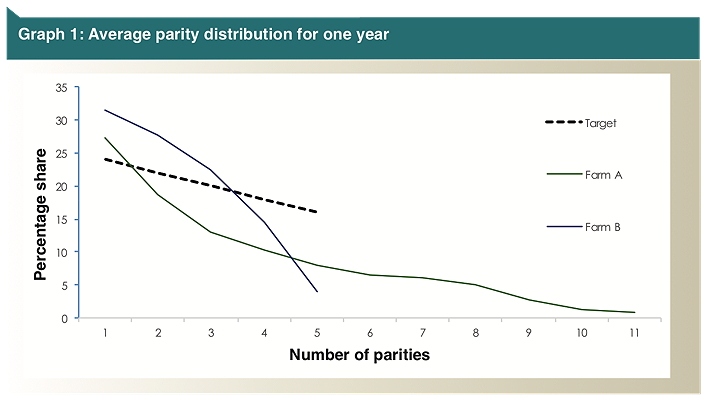
If you question this assumption, then look at the data row for ‘Average weaning weight/litter’. The difference here is significant, and to understand this you’ll need to study Graph 1. This shows the parity distribution of the two farms, reported as an average for a period of one year. Also shown is the target I set for the businesses that I work with.

Farm A is averaging eleven parities in production and Farm B five. The significant difference in overall litter weight can be due to a number of factors. Low weaning weights are being reported against the parity-one animals in Farm A. The poor reproductive management of the gilt in relation to conception could be further compromised by a corresponding poor management of lactation, producing a ‘light’ piglet at weaning.

It could just be that Farm A weans earlier than Farm B. If this is the case, then this factor is further propping up the comparative performance and, like for like, would make the difference in farrowing index greater and in real terms lower the output.
Either way these weaning weights will have a significant bearing on the cost efficiency of the feeding herd. Farm A has good genetics because of the numbers result they are getting despite poor gilt management that introduces a percentage of ‘old’ gilts into production, which immediately puts pressure on the number and quality of the overall herd output.

Financial value
To establish a relative financial value against the management practises of the two farms, I look at the difference between the number of piglets born alive to sows that record a farrowing within a service group, and then again at the number born alive to the total number of serves originally recorded against the sows in that service group. These are set against the average cost of a sow’s production cycle.

The purpose of this is simple as it demonstrates the reality of breeding herd performance in terms of cost. The average cost of a production cycle of the gilt and sow is something every producer and manager should know. This figure informs management ‘on the hoof’. For example, when standing by a freshly farrowed sow that has just delivered four stonking great piglets, it is worth calculating what they have cost. This is easy if you know the cost of the production cycle; if it’s £350, then these four cracking piglets have each cost the princely sum of £87.50. Management actions to record against the sow are: foster on surplus pigs (tick), cull at weaning (tick).
1601-Hall_B

In Table 2, a cost of £350 is set against the production cycle for Farm B. This cost includes the total expenditure of the business divided by the number of completed production cycles in the period of that expenditure, including depreciation, imputed costs and valuation change. Farm A’s cost has been adjusted to allow for the difference in the rate, and therefore the cost, of breeding herd replacement.

The average number of pigs born alive per parity divided by the total number of serves made in that period, including the re-service rate and the farrowing rate, is then divided into that cost. In the column for parity one, the difference in cost per piglet born alive between Farm A and Farm B is minus £10.69. This is putting a value on the result of all that has been looked at in this article.

These financial values are a reference point to help understand how the points raised here relate to each other. Overall, Farm B with a management strategy of not serving returns, superior gilt management and a process control parity distribution of one to five produces piglets at almost £3.00 less than Farm A, which is also producing a smaller and potentially less-efficient feeding herd pig. This is despite the fact that Farm A is getting two-and-half more production cycles from the breeding females before culling.

For me, this supports a compelling argument that retaining failing animals within the business is not a viable proposition. Farm A will produce 3,257 weaned pigs and Farm B 3,367 weaned pigs per 100 breeding females. This amounts to a difference in output cost of £6,515 per 100 animals – that’s more than £30,000 for herds of 500-plus animals.

Weaker/lighter weaners could increase the cost of production by at least £7.00 per pig. The total difference between Farm A and Farm B could be at least £10.00 per slaughter pig in favour of Farm B.

Share. LinkedIn Facebook Twitter Email
Previous ArticleFarm commissioner Hogan expresses “hope” over PSA launch
Next Article Sireline change leads to greater finishing herd performance and profits
Guest Writers

Read Similar Stories

ForFarmers launches new data analysis tool

July 7, 2018

“I want to become one of the really good guys”

August 1, 2017

Sights set on the finishing line

March 3, 2015
Latest News

Government highlights £54m investment to tackle national biosecurity threats

October 9, 2026

Red Tractor to consult on flexible farrowing standards

October 9, 2026

Comment: Is once-proud Scots pig sector heading for a terminal decline?

October 9, 2026
Sponsored Content

Want more from your sows? It’s time to add claw lesion checks into your herd protocol

October 1, 2026

Setting piglets up for a smoother weaning transition

July 1, 2026
Current Pig Industry jobs
  • Multiplication Senior Stockperson – Ref 1938 Berwickshire

    • Scottish Borders
    • Roadhogs Recruitment Ltd.
    • Full Time
  • Experienced Pig Stockperson – Ref 1937 West Yorkshire

    • West Yorkshire
    • Roadhogs Recruitment Ltd.
    • Full Time
  • Pig Stockperson – Ref 1936 Aberdeenshire

    • Aberdeenshire
    • Roadhogs Recruitment Ltd.
    • Full Time
GETTING IN TOUCH
  • Advertise
  • Contact Us
  • Meet The Editors
  • About Us
  • Email Newsletters
  • Subscribe
  • Reuse permissions
OUR SOCIAL CHANNELS
  • Twitter
  • LinkedIn
PARTNER EVENTS
RELATED SITES
  • Farmers Weekly
  • Agronomist & Arable Farmer
  • Farm Contractor
  • National Pig Awards
  • Pigs Tomorrow
  • Poultry News
  • Weekly Tribune
  • Privacy Policy
  • Cookies Policy
  • Terms and Conditions
© 2024 MA Agriculture Ltd, a Mark Allen Group company

Type above and press Enter to search. Press Esc to cancel.