




A leading industry planning consultant has called for the government to intervene, after a wave of judicial reviews brought by campaigners have turned the planning process into what he described as a ‘legal minefield’.
“Livestock planning is broken, and farmers are paying the price,” said Ian Pick, a director at Harrison Pick. He pointed out that national planning policy ‘clearly supports livestock production in principle’. “Yet getting permission for a broiler, breeder, pig, dairy, game or fish farm has never been harder,” he said.
In mid-October, Communities Against Factory Farming (CAFF) announced that the High Court has granted permission on all grounds in a challenge to planning permission for a ‘replacement intensive chicken shed’ at a farm in Essex.
It said the claim raises concerns about the council ‘relying on inconsistent information (and bare assurances from the applicant) regarding the scope of the proposed operation, as well as its inadequate consideration of environmental impacts and animal welfare’.
A central issue was whether the council should have required an environmental impact assessment (EIA) or undertaken screening to determine whether one was necessary. The claim also concerns animal welfare benefits advanced in support of the application. A substantive hearing is likely to occur in early 2027.
CAFF’s director, Maya Pardo, said: “This case is hugely important for stopping the spread of factory farming, which is so harmful to animals and the environment.”
In September, CAFF claimed a ‘huge win’ after West Lindsey District Council overturned a decision made in June to permit an intensive poultry farm in Lincolnshire. This followed a judicial review claim against the decision filed by CAFF in July.
CAFF challenged the council over how it assessed the effects of manure and dirty water, including a failure to assess the ‘indirect effects’ of transporting manure off the site. The campaign group said it was ‘the fifth factory farm that CAFF has successfully overturned through legal action’.
Mr Pick highlighted further judicial reviews launched by CAFF targeting pig and poultry applications. “The CAFF legal challenge machine is now in overdrive,” he wrote on LinkedIn in mid-October.
“We have yet another pre-action protocol letter for judicial review, this time attacking the East Riding of Yorkshire Council, on a prior approval for a sub-1,000sq m extension to a pig shed in the East Riding of Yorkshire council area.”
This followed hot on the heels of another CAFF judicial review pre-action protocol, targeting West Suffolk Council.
Complex case law
“CAFF now runs large, well-funded objection campaigns against almost every intensive livestock application in the country,” Mr Pick said.
“When permission is granted, a pre-action letter for judicial review follows. Years of litigation have turned these applications into a legal minefield.
“The case law on what must be assessed is now so complex that you would need an experienced barrister, not a council planning officer, to get through it. When London barristers go through a planning officer’s report line by line, the officer loses that argument almost every time.”
Over the past 12 months, only about 11 local planning authorities ‘have been willing to decide an intensive livestock application’, and, each time, a pre-action letter was sent. In 10 of those cases, the council’s counsel advised it to concede, the latest example coming in late October.
“Only West Lindsey District Council has stood its ground and defended its decision” Mr Pick said. “Everywhere else, the council conceded and the farmer’s permission was lost, after 18 months and significant cost to get there.”
“As a result, an application that should be decided in 16 weeks is now taking about 18 months to two years, only to be challenged as soon as it is approved.”
About CAFF
Communities Against Factory Farming (CAFF) is the grassroots campaigning arm of activist group Animal Rising and forms part of its ‘No New Factory Farms’ campaign.
It describes itself as a coalition of local residents, farmers, lawyers, environmentalists, politicians, councillors and activists that aims to ‘support and empower communities to challenge factory farm planning applications and campaign for national legislation change’.
It does this by, for example, producing template letters for the public to challenge planning applications, as well as guides on how to launch campaigns and leaflets citing opposition to factory farming. It also launches legal action against councils involved in planning decisions.
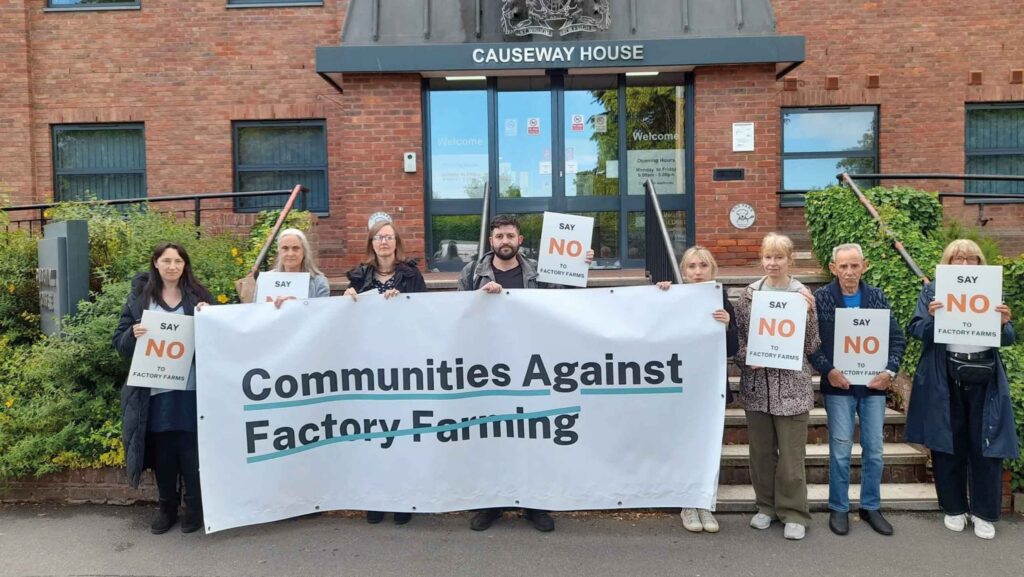
CAFF is funded through public donations, community supporters and targeted legal crowdfunding campaigns.
Its website lists more than 60 current campaigns against planning applications across the UK. The majority are poultry farms, but they include 11 pig farms – six in Yorkshire, two in Norfolk and units in Essex, Staffordshire and Northumberland.
There is also a campaign targeting Pilgrim’s Europe’s plans to expand its Westerleigh abattoir, in Gloucestershire, to kill an additional 6,000 pigs a week.
Last year, CAFF was instrumental in coordinating the campaign against Cranswick’s proposals for large, high-welfare pig and poultry units near the villages of Methwold and Feltwell in Norfolk.
King’s Lynn and West Norfolk Borough Council rejected the application in April 2025, after being recommended to reject it due to a ‘lack of information’ about its impact on ecology and climate change.
“So far, we’ve stopped 6.7 million animals from entering the food system through direct legal challenges and by campaigning that has led to applications being withdrawn,” CAFF said.
Downstream effects
Mr Pick said the arguments put forward keep stretching further and are becoming harder to defend.
Since the landmark ‘Finch’ Supreme Court judgment, brought by the Weald Action Group against Surrey County Council, ‘downstream effects’ must be taken into account in EAIs. This is being pushed to ‘absurd lengths’, Mr Pick said.
For example, in the Lincolnshire case, chicken farm permission was deemed unlawful because the effect of ash from a separately permitted power station in another county was not taken into account.
“Planning officers cannot be expected to assess every facility that a farm’s by-products might pass through, each with its own consents and environmental permits,” he said. “This isn’t working for anyone: not farmers, not councils, not local communities and not our food security.
“The biggest problem is that there is a massive disconnect between the way in which councils are processing planning applications and what the law requires. Simply, local planning authorities lack the knowledge and understanding of the legal requirements of the planning system to issue a lawful planning permission and they are getting hammered for it by CAFF barristers every time. The whole process needs ripping up and starting again.
“The government needs to step in,” he said. “We need clear planning guidance specific to livestock farming, prepared with proper stakeholder consultation, that sets out what an EIA for a livestock unit must and must not cover. Until then, councils will keep conceding and good farm businesses will keep paying the price.”
Mr Pick pointed out that livestock farmers are trying to ‘feed the nation’, adhering to UK welfare and environmental standards, but warned if campaigners succeed in stopping UK farmers from expanding and putting up new units, the net effect will be more imported food that will, in many cases, have been produced to lower standards.
Clarity needed
In August, the government published a new National Planning Policy Framework (NPPF), which it said sets out national planning policy ‘in a clearer and more comprehensive manner and incorporates a number of substantive reforms designed to boost housing supply and unlock economic growth in the years ahead’.
The NPPF is intended to:
- Make development management more certain, consistent and streamlined
- Standardise policies that apply across the whole of England
- Reduce duplication and avoid unjustified local deviation from national policy in local plans.
NPA chief executive Lizzie Wilson said: “Barriers to securing planning permission are increasingly holding farmers back from improving efficiency and delivering on higher welfare and environmental standards – for example, transitioning to flexible farrowing.
“Ultimately, it is compromising the UK’s food security. The revised NPPF was meant to provide better support for planning requirements throughout the farming sector, but, sadly, it doesn’t help local authorities defend applications against this type of well-funded and highly organised anti-farming campaign.”
“We need clarity from government to give councils the freedom to make balanced decisions without fear.”
Pig World asked Defra to comment.