



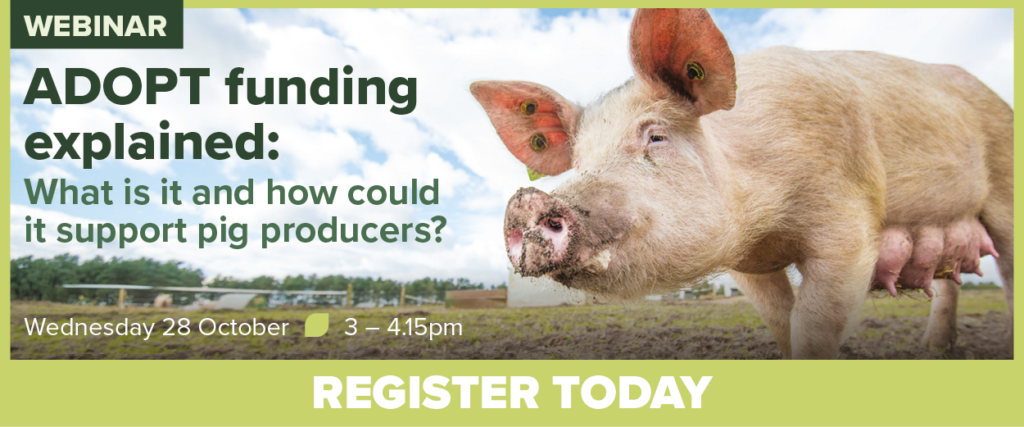
Pig farmers and businesses across the sector can still access a webinar exploring how ADOPT can support farmer-led trials of practical ideas and technologies.
The Pig World webinar, in association with the ADOPT Support Hub and agricultural facilitator Sam Hoste, was held on Wednesday.
- You can still listen by registering HERE.
ADOPT supports farmer-led innovation projects that test whether new approaches work in commercial farming conditions.
Full project grants range from £50,000 to £200,000, with up to 80% of eligible project costs funded. Smaller support grants of up to £2,500 are also available to help farmers develop an idea and access specialist support before submitting a full application.
Awareness of ADOPT remains relatively limited within the pig sector, despite the programme offering an opportunity for all farmers to secure funding to test solutions to challenges within their businesses.
The webinar explained what support is available and looked at whether a problem, idea or potential solution from their own businesses could be developed into an application.
The covered who can lead a project, the role of an ADOPT facilitator and how farmers can work alongside other producers, researchers, vets and technology or solution providers.
It also featured the NPA’s Katie Jarvis and an example from Holmefield Farm Services and a group of more than 20 Yorkshire farmers involved in an existing ADOPT project investigating how medication delivered through drinking water can be mixed and distributed more effectively, helping ensure it reaches the pigs rather than settling within the system.
 Ms Jarvis said ADOPT funding was a ‘great opportunity’. “There is already so much going on in the industry, with new ideas, technology and ways of addressing problems emerging all the time, and I know there are always trials taking place on farm, with producers testing out ideas and building new kit to try to find solutions,” she said.
“The smaller £2500 grants to test ideas and engage with experts is a great place to start for many.”
In terms of potential areas where the pig sector could benefit from the funding, she highlighted antibiotics in water, pen-side disease testing, biosecurity and hygiene measures as general themes.
Heat stress is a another big topic. For outdoor producers, Katie highlighted projects to create shaded areas for pigs in hot weather, and, for the indoor sector, technologies like evaporative cooling systems and cooling pads, as potential projects that could benefit from the funding.
Slurry storage and management is also a big issue that could warrant further investigations, she said. Another is emissions management and Katie identified air scrubbing – air that leaves the building at one point and passes through a ‘blotting paper’ with running water which effectively cleans the air before the air leaves the building – as a potentially valuable on-farm project.
“There are many more ideas which those in the industry are probably already discussing, so I really urge you to investigate the funding available and make the most of this opportunity,” she said.