




Higher domestic productivity contributed to increased export volumes and lower imports over the first half of this year.
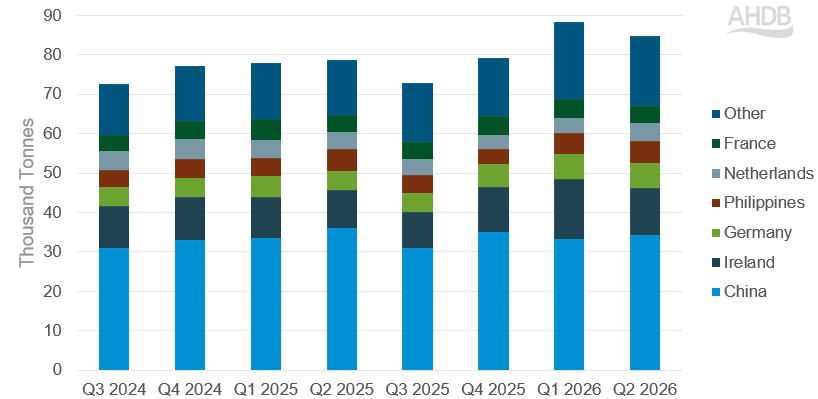
Despite dropping back slightly in Q2, UK pigmeat exports were up 11% year-on-year over the first half of 2026, supported by increased domestic supply and continued demand from key overseas markets.
The 84,700 tonnes exported in Q2 was 4% down on the high levels of Q1, but volumes remained higher year-on-year, according to AHDB’s summary of HMRC data.
Over the first half of 2026, volumes were up 11% year on year at 173,200 tonnes, £267.2 million, up 5% from the year before, reflecting lower prices paid.
Exports to China, at 34,200 tonnes, increased by 3% in Q2 on Q1, but were 3% down year on year. Fresh and frozen pork made up a larger proportion of this volume, accounting for 43%, up from 34% a year ago, with the remainder being offal.
Volumes exported to the EU dropped by 11% compared with Q1, with quantities to Ireland, Denmark, Germany and France all falling. However, EU export volumes were up up 15% year on year in Q2.
This brought the total volume of pig meat exported to the EU for the first half of the year to 73,100 tonnes, more than went to China and up 19% compared with the first half of 2025.
Quarterly UK pig meat (incl. offal) export volumes by destination in thousand tonnes from Q3 2024 – Q2 2026
Source: HMRC via Trade Data Monitor LLC
Shipments to the Philippines grew by 7% on Q1, bringing year-to-date volumes up by 8% year-on-year, while exports to South Africa grew by 14% quarter-on-quarter, with most growth in offal.
AHDB said increased domestic supply supported the export boost, driven by heavier carcase weights and higher slaughter numbers.
“Disease disruption and shifting global demand continue to reshape trade flows, creating opportunities in markets such as South Africa and the Philippines while Chinese demand remains subdued,” AHDB said.
Imports
Imports of pig meat (including offal) into the UK increased by 1% in Q2 on Q1, although volumes were down by 8% year on year.
Quarterly UK pig meat (incl. offal) import volumes by origin in thousand tonnes from Q3 2024 – Q2 2026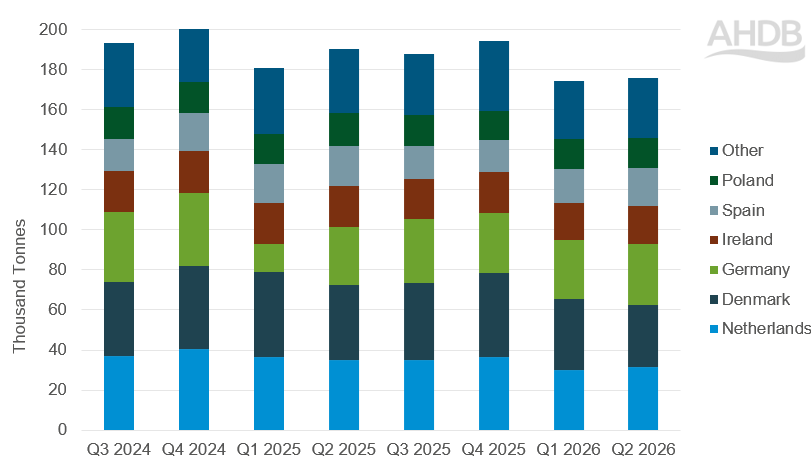
Source: HMRC via Trade Data Monitor LLC
Over, the first half of 2026, import volumes were 5.6% lower year-on-year, at just over 350,000 tonnes. Greater supply in the UK has likely contributed to smaller import volumes, according to AHDB.
Q2 volumes from Denmark were down 12% on Q1 to 31,000 tonnes, and continue to be replaced with product from other European markets, including Spain, the Netherlands and Germany.
The volumes from Germany continued to grow, up by 3% in Q2 compared to Q1 as trade recovers following earlier restrictions, while volumes from the Netherlands, Ireland, Spain and Poland rose in Q2 compared to Q1 but remained lower year-on-year.
The volume of bacon imported dropped by a further 3% on Q1, as volumes of bacon in UK retail dropped by 4.7% year-on-year in the 12 weeks ending July 12. “These declines could be influenced by consumers shifting away from more heavily processed/ultra-processed foods,” AHDB said.
Import volumes are down at a time when low EU prices mean the UK-EU reference pig price differential is wider than typical levels, averaging 40p in Q2.
Self-sufficiency
Taking into account domestic production, import and export volumes, the UK’s self-sufficiency – as measured by domestic production as a percentage of available supply – has increased to 66% in the first half of 2026, up from 61% in the first half of 2025.