



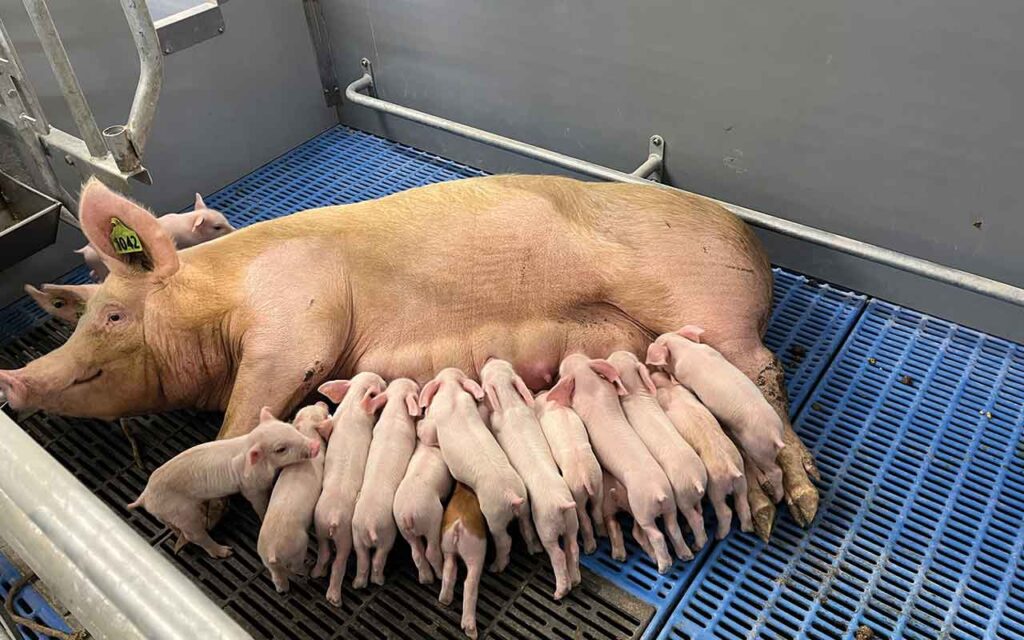
The transition to flexible farrowing systems could change the whole structure of the British pig industry, so it needs to be handled very carefully, according to ARM Buildings’ Tim Miller, who has specialist knowledge in this area.
In the UK as a whole, the split between indoor and outdoor herds is about 50:50, he estimates. In England and Scotland, where the majority of pigs are produced, the ratio is probably nearer 40:60, while there are a limited number of outdoor sows in Northern Ireland.
“It’s hard to get accurate figures, but my reckoning is that there were 55,000-60,000 conventional indoor farrowing places in 2019 – since then, about 6,000 flexible pens have been installed. A further 1,000 are under way this year and there are more in the pipeline for 2027,” said Mr Miller.
“I know of 150 purpose-built, totally free places with, possibly, 200-250 such places in old, houses, mostly byres, shippons or stables on small farms, often involving rare breeds.”
Mr Miller believes the move to outdoor production for breeding sows may have peaked due to various limitations, particularly the availability of suitable land and also staff who are prepared to work on such units.
“Outdoor units may be considered high welfare for the pigs, but not necessarily so for the staff, so some farms are struggling. One man, in his early 30s told me that he couldn’t keep going for much longer.”
Major European pig-producing countries are also moving to flexible farrowing, so they will be in ‘higher welfare’ competition with British producers in the future.
“Outdoor production will never be able to supply all the UK’s pigmeat needs, so there will be a continued need for indoor units,” Mr Miller stressed.
“Outdoor-produced pigs fetch a premium, reflecting the extra costs, but whatever the split between the indoor and outdoor sectors, there will still be a market for high-welfare pork produced from indoor herds for the non-premium sector – and this is where UK producers come in direct competition with those in Europe. We will have to be seen to be on a level with – or better than – European countries.”
So where does that leave the UK? Mr Miller stressed that an adequate transition period to move to flexible farrowing will be vital. “I fear the authorities still do not fully understand the actual logistical and production problems faced by farmer,” he said.
Key stats
Conventional pen size:
- 4.32sq m (2.4×1.8m) – The typical area for sows in conventional farrowing crates.
Flexible pen size:
- 6.24sq m (2.4×2.6m) – This is a common area used on farms that have already installed flexible farrowing pens. Many units have gone for this size in the absence of any legislation.
- 6.5sq m (2.5×2.6m) – This is likely to be the size deemed ‘adequate’ and adopted in Europe.
Mr Miller said the two examples of flexible farrowing pens above provide 6.24sq m or 6.5sq m of total pen space – but is not the free area for the sow.
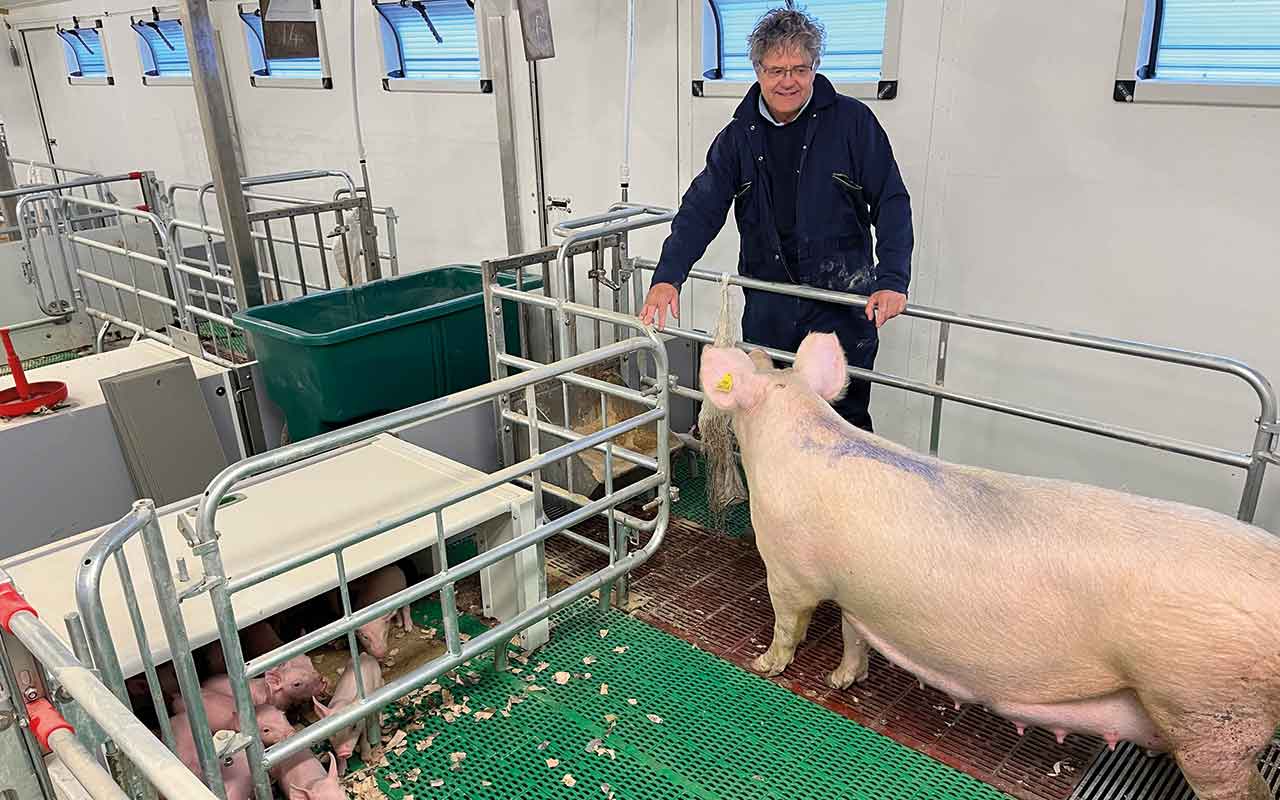
He stressed it was important to distinguish between the area of the whole pen (the footprint) and the free area for the sow. The free area should allow the sow to turn around comfortably and lie down. He suggests a turning circle of 1.8m in diameter in addition to a safe creep area for piglets.
Financial cost
Firstly, there is a considerable financial cost. Each flexible farrowing pen takes up 50% more space than a conventional pen with a crate. A farmer must, therefore, make choices.
If they convert existing buildings, this will mean fewer farrowing pens are available for the normal schedule during the conversion, resulting in downsizing the herd and also partially going out of production, resulting in a loss of income.
As an example, a 64-place farrowing room converted to put in a 6.24sq m flexible system would then only hold 48 places. This would require the building of an extra 16 places to maintain the herd size.
A conversion would cost between £2,200 and £2,600 per sow place, including new flooring, plus the £6,600-£7,000/sow place of building a new house to hold the necessary extra pens.
The alternative is to put up new buildings just to house the same number of sows. But there is a major problem here.
“Not all farmers have the space available for new buildings or are able to fit them in to work with the existing layout. Even if they have, they will need to get planning permission, and this is becoming notoriously difficult and often takes over a year. Due to the demand, delivery of the equipment can take six months,” Mr Miller pointed out.
Most farmers have decided to build new accommodation, rather than convert, but the cost works out at about £6,000-£7,000 per sow place, he said.
Recent world events mean all costs are subject to inflation.
‘Grandfathers’ rights’
Early adopters of flexible farrowing systems have already invested millions of pounds in the system prior to any legislation and so should not be penalised if the legislation gives a final footprint slightly large than those already installed. They should qualify for ‘grandfathers’ rights’,
he said.
If a farmer has been granted planning permission before any legislation for a building that is smaller than the legislation might allow, they should not be expected to resubmit plans for a larger building.
The time taken from the initial drawing, getting the right equipment and actually constructing the building can be 18 months, so this should be respected.
In addition to these problems and the disruption to production, there is the additional task of minimising the biosecurity risk caused by builders on the farm working within the area of occupied houses.
Emotive campaigns
“Welfare organisations should support these moves rather than conduct emotive campaigns,” Mr Miller added.
He said the best way forward was for them to work with industry bodies and to fully understand what the industry is trying to do by improving systems rather than just stopping pig farming.
“They should be encouraged to support planning applications relating to welfare-friendly systems,” he said.
In these uncertain times, we should also consider food security. If British pig farmers are put out of business, the public are not going to stop eating pork and the supermarkets and processors will simply source their supplies from overseas, where we will have less control over welfare.
“The government should therefore ensure a realistic transition period. If
not, as happened when sow stalls were abruptly banned, producers could be forced out of business, particularly independent producers.”
What Defra has said about the farrowing transition
Defra set out its broad position on the transition away from conventional farrowing crates in the Animal Welfare Strategy, published just before Christmas.
The strategy states that ending the use of cages and crates is a ‘key priority’ for the government. Proposals to phase out all colony cage systems across the laying hen sector by 2032 were published for consultation days into 2026.
Uncertainty
However, even though a potential ban has been discussed within Defra for many years, there is still no sign of any formal proposals on farrowing crates, or further details on what the transition could look like and the timings. A consultation is expected this year, but that is far from certain.
The document says that Defra wants to work with the sector to ‘move all sows out of farrowing crates over a sustainable transition period’.
It confirms that the transition to ‘alternative systems’ could be in the form of ‘either flexible farrowing where the sow is confined around farrowing, or free-farrowing, with no confinement during farrowing or lactation’.
It states that ‘a significant number’ of sows are confined in farrowing crates from around five days before farrowing until weaning at approximately 28 days.
“A farrowing crate, which is designed to protect piglets from being crushed by the sow, restricts the sow’s movement, preventing her from turning around and performing natural behaviours, such as nest building,” the document stated, noting that 50% of the national sow breeding herd already farrow without confinement on outdoor units.