



The government has confirmed plans to ‘move away’ from farrowing crates and ban the use of CO2 in abattoirs, as it unveils its new Animal Welfare Strategy.
The long-awaited strategy, which also covers pets and wild animals, sets out how the government aims to improve the welfare for farmed animals in various ways.
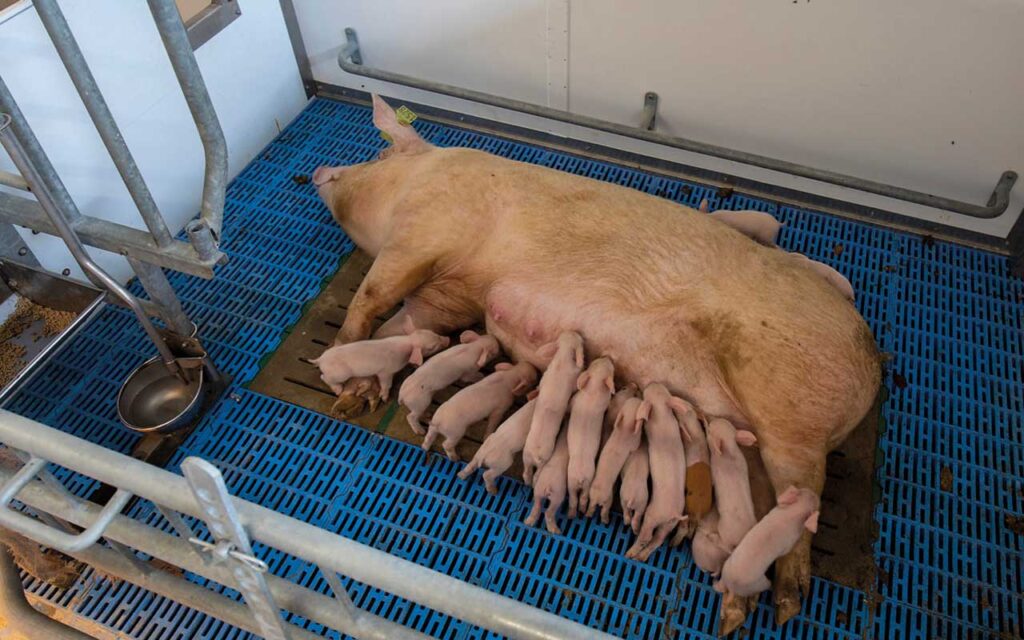
Farrowing crates
This includes working with the industry to ‘explore how to transition away from the use of farrowing crates to alternative systems’. It confirms that this could be in the form of either flexible farrowing where the sow is confined around farrowing, or free farrowing, with no confinement during farrowing or lactation.
There is a pledge to consult on the transition and, while no timescale is specified, the industry is expecting this at some point in 2026. A consultation on phasing out enriched ‘colony’ hen cages is also expected next year.
The NPA estimates that a total of around 5000 flexible farrowing places are already in use across the UK, with another 1,000 places currently in the planning phase.
The pig sector has already made progress in voluntarily moving away from conventional crates towards flexible systems – and will be seeking assurances that any legislation governing the transition provides a sufficient timescale and support for producers.
The document states that Defra wants to work with the sector to ‘move all sows out of farrowing crates over a sustainable transition period’. “Removing the use of intensive confinement systems is an essential component of the government’s plan to ensure all farmed animals have a life worth living, and that as many animals as possible have a good life. Ending the use of cages and crates is therefore a key priority for this government,” it says.
Banning CO2
For the first time, Defra confirms that it will ban the use of carbon dioxide gas stunning of pigs, subject to a consultation
The strategy states that there is ‘a pressing need to address the welfare issues associated with high concentration CO2 gas stunning of pigs’.
Defra commissioned the Animal Welfare Council to provide an up-to-date assessment of the current evidence on high concentration CO2 stunning of pigs and potential alternative stunning methods. The AWC concluded that ‘to prevent pigs from experiencing avoidable pain, distress or suffering at slaughter associated with high concentration CO2, its use should be prohibited and that the transition period provided should be as short as possible’. It also concluded that argon gas stunning and automated electrical stunning are higher welfare alternatives.
“These are commercially feasible alternatives, and we therefore want to see an end to the use of CO2 gas stunning,” the strategy said
The government is expected to consult on CO2 in abattoirs next year. However, the industry has been clear that CO2 must not be banned until a proven alternative is in place.
Other farm animal commitments
Defra has announced that farm animals in England and Wales will be better protected from dog attacks thanks to new Livestock Worrying laws. Tougher penalties and greater police powers will help relieve the emotional and financial strain these attacks place on farming communities.
Other animal commitments include:
- Working in partnership with farmers and vets through the framework of the Animal Health and Welfare Pathway, to improve the health and welfare of livestock
- Working with the sectors to improve welfare during transport, reduce the prevalence of painful mutilations, and ensure breeding practices do not cause any unnecessary suffering. This includes ‘reducing the prevalence of pig tail docking, working with the industry and the veterinary profession’ and ending the practice of beak trimming of laying hens.
- Encouraging industry to end the practice of culling male laying hen chicks
- Publishing a review of the Welfare of Animals at the Time of Killing (England) Regulations 2015 to ensure that the regulations still meet their objectives
- Publish and consider carefully a report from the AWC on breeding and breeding practices, including how we reflect advice in the welfare codes.
- Work with relevant stakeholders, including farming and food industry stakeholders, vets, scientists and animal welfare NGOs to continue exploring how improved food labelling, including method-of-production labelling, could improve animal welfare.
- Publish and consider carefully the reports from the AWC and support work to help the poultry and livestock sectors adapt to the effects of climate change.
- Championing high animal welfare standards around the world, including considering whether overseas produce has an unfair advantage and be prepared to use the full range of powers to protect our most sensitive sectors.
In one of the biggest headlines from the strategy, the government also sets out its intention to ban trail hunting amidst concerns it is being used as a smokescreen for hunting.
Defra secretary Emma Reynolds said: “We’re a nation of animal lovers. This government is delivering the most ambitious animal welfare strategy in a generation.
“Our strategy will raise welfare standards for animals in the home, on the farm and in the wild. We’ve already acted to improve zoo standards, end puppy smuggling and protect livestock from dog attacks. Now, we’re planning to ban caged hens, cruel snares, trail hunting, and curb low welfare dog breeding.”
Reaction
NPA chief executive Lizzie Wilson said: “We welcome the government’s overarching strategy on animal welfare but continue to urge an evidence-based approach, taken in conjunction with industry expertise, to design and implement future policies which deliver for both animals and producers.
“Similarly, it is vital that we uphold these production standards as part of future international trade. Implementing core standards will prevent UK farmers’ animal welfare and sustainability efforts from being undermined and ensure that the UK does not simply offshore food production to countries with cheaper, less sustainable systems and lower animal welfare standards.
“Allowing goods into the UK produced to standards that would not be legal for our producers, would represent a betrayal to British farmers.”
An Association of Independent Meat Suppliers (AIMS) spokesperson said: “We will take our time to read the Animal Welfare Strategy for England, and, as the largest industry body representing the abattoir sector, carefully consider the implications for our members and, where required, respond to proposed consultations.
“However, we are very concerned that the strategy fails to address one of the main threats to animal welfare faced by farmers, hauliers, and abattoirs, namely the activities of ideologically driven extremists.
“We urgently call on the Government to adopt a more robust approach to these individuals and groups who seek to disrupt the lawful operation of the livestock farming and processing sectors, both of which are designated as areas of critical national infrastructure.”
Thomas Schultz-Jagow, Director of Advocacy and Prevention at RSPCA, said: “The government’s new Animal Welfare Strategy is a significant step forward which has the potential to improve the lives of millions of animals.
“People in the UK love animals and they want to see governments leading the way to outlaw cruel practices which cause suffering such as a phase out of cages for laying hens and farrowing crates for pigs.”
Charlotte Di Cello, chief commercial officer at Waitrose, comments: “The Animal Welfare Strategy is an important step towards better lives for farmed animals. Shoppers want higher welfare standards and it is really good to know that some of the more inhumane methods of farming, such as fast-growing chickens, will be consigned to history in the UK.
“Our new welfare rating label has been welcomed and we are hopeful the strategy will be a springboard to a mandatory scheme in the future to boost transparency and more conscious choice for shoppers.”