




The global pork industry will see uneven production growth while trade patterns continue to shift in 2026, with Brazil becoming an increasing force, according to RaboResearch’s latest quarterly pork report.
Global pork production is expected to increase in the first half of the year, driven by ‘modest’ growth in the US, EU, and China and ‘steady’ continued growth in Brazil.
“The driving forces for growth vary by region,” explains Chenjun Pan, Senior Analyst – Animal Protein for RaboResearch. “Productivity improvements weigh more than previously in the US, China, the EU and Brazil, while the large herd size is another main cause of output growth for China.”
Production in the second half of 2026 is expected to slow down and even decline, however, largely driven by the herd reduction in China and Spain, which faces ASF-related trade constraints that will lead to herd reduction’s Ms Pan added.
In China, producers will scale back to rebalance the herd. Its recently-announced policy to reduce sow numbers by 1 million head, 2.5%, will cut the global sow mherd by 1%.
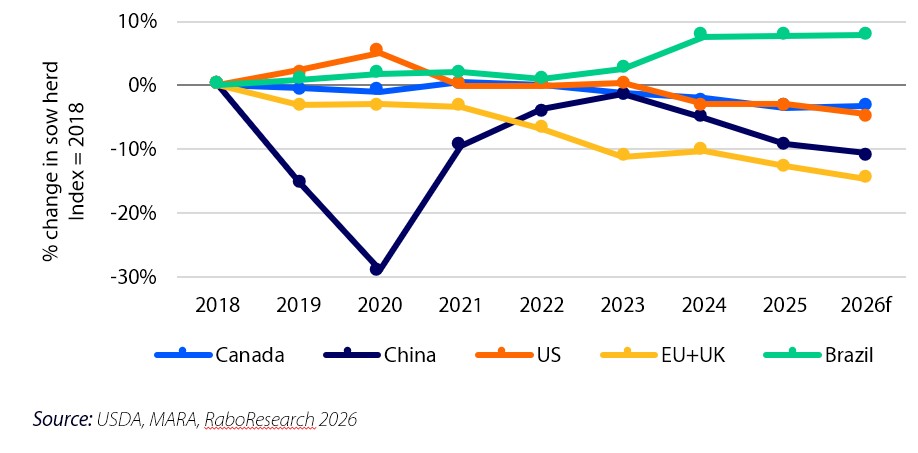 However, this will be partly offset by continued growth in Brazil’s sow herd, driven by favourable margins and export growth.
The RaboResearch report highlights several factors will impact global supply, including biosecurity, disease pressures, relatively high construction costs and trade restrictions. The focus of producers will be on productivity, cost reduction and cautious expansion, it predicts.
Uneven 2025 trade performance
Trade policy changes in major countries will continue to reshuffle trade flows in the coming year. Global pork trade showed an uneven performance in 2025, as Brazil’s presence in the global market grew with 12% export growth, expanding its share of the global market from 12-15%, while other key exporting countries, such as the US and Canada, saw single digit declines.
Into 2026, major importing countries, including China and Mexico, are adjusting import policies. Mexico will introduce import quota to non-FTA suppliers and launch anti-dumping and anti-subsidy investigations into US pork, while China imposes anti-dumping duties on EU pork imports, the report added.
Japan and the Philippines, major importers, are maintaining bans on Spanish pork due to ASF concerns. All these developments suggest trade volatility will continue in 2026.
Herd health challenge
ASF continues to spread in Vietnam and the Philippines, hindering local production recovery. Although ASF has not affected the domestic herd in Spain, the industry faces increased pressure from stricter biosecurity and disease control measures. PRRS continues to weigh on production in the US and Mexico, the report notes.